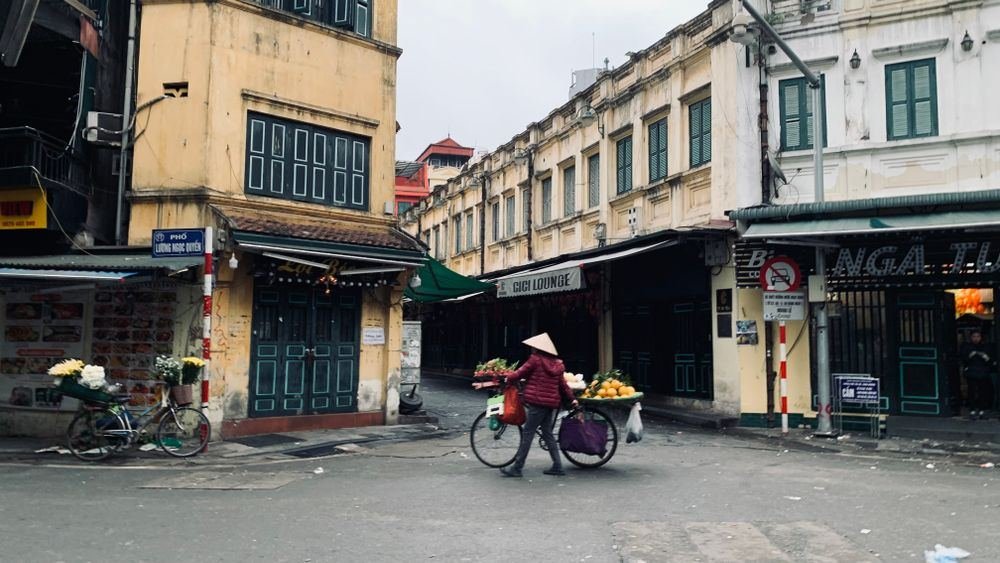
The Old Quarter is where most visitors spend the bulk of their time in Hanoi, and for good reason. Around 1 square kilometre of narrow streets sits just north of Hoan Kiem Lake, packed with shophouses, temples, noodle stalls, hostels and hotels. This guide covers what the streets are, how to walk them, what to eat, what is happening with train street in 2026, where to stay, and how to handle the nightlife. For the wider city, start with our Hanoi guide.
The 36 streets and their trades
Hanoi’s Old Quarter grew up around the royal citadel of Thang Long, and from around the 13th century craft guilds from surrounding villages settled here and sold from their own street. The tradition is why many street names start with Hang, meaning goods or merchandise, followed by the product. The “36 streets” is a traditional phrase; today the area holds roughly twice that many named streets, and few still sell only their old product. Some trades have survived surprisingly well.
| Street | Original trade | What you find today |
|---|---|---|
| Hang Bac | Silver | Jewellery shops, and the old silversmiths’ guild temple |
| Hang Gai | Silk and hemp | Tailors, silk shops, souvenir stores |
| Hang Ma | Votive paper | Paper lanterns and decorations, very colourful around festivals |
| Hang Quat | Fans and ritual goods | Red and gold altar items, flags and temple supplies |
| Hang Dao | Dyed cloth | Clothing and accessories, the start of the weekend night market |
| Hang Thiec | Tin | Tinsmiths still hammering and cutting metal |
| Hang Dong | Copper | Hardware and metalwork |
| Hang Be | Bamboo rafts | Food stalls and backpacker hostels |
| Hang Buom | Sails | Cafes, guesthouses and the old Bach Ma Temple |
| Hang Muoi | Salt | Quiet, residential-feeling stretch |
| Hang Chieu | Mats | Home of the old east gate, and a pedestrian-friendly stretch |
| Hang Non | Conical hats | Souvenirs and daily goods |
| Hang Ga | Chicken | Spice, snack and bánh cuốn vendors |
| Hang Than | Charcoal | Small shops, still used for grilling |
| Lan Ong | Herbal medicine | Dried herbs and medicinal roots, strongly scented |
| Hang Trong | Drums | Painted Dong Ho folk art and framed prints |
Streets change hands over time, so treat the table as a guide to the street’s history rather than a shopping list. The pleasure is in walking the grid and noticing that the shop next to the tin worker sells noodles.
Tube houses
You will notice the buildings are narrow and deep. Historically, tax was assessed on the width of the street frontage, so merchants built tube houses a few metres wide and tens of metres long, with courtyards inside. The house at 87 Ma May is a preserved example open to visitors (entry around 25,000 VND), which makes it a good first stop if you want to see how families lived and worked above the shop.
A self-guided walking route (about 2.5 km, 2 to 3 hours)
Start early, ideally before 9am, when the streets are cooler, quieter and the morning food stalls are at their best.
- Hoan Kiem Lake, north shore. Begin near the water-puppet theatre side and walk up Dinh Tien Hoang into Hang Dao.
- Hang Dao and Hang Ngang. Clothes and trinkets, then turn into the Ma May area for tube-house architecture.
- Hang Bac. Silver and the small guild temple tucked among shops.
- Hang Ma and Hang Quat. The most photogenic part, especially in the lead-up to Tet and Mid-Autumn Festival.
- Bach Ma Temple, Hang Buom. Among the oldest temples in the city, with origins traced to between the 9th and 11th centuries depending on the source. It is small, quiet and free to look around.
- Dong Xuan Market at the northern end. The big covered market sells wholesale goods and has a food hall on the upper floor.
- Return via Lan Ong and Hang Be, stopping for lunch at a street stall.
If you want context while you walk, a guided stroll is the efficient route. Browse Hanoi tours and walking experiences or our roundup of the best tours in Hanoi. See also things to do in Hanoi for what sits beyond the Old Quarter.
Street food stops and prices
All prices are approximate and as of 2026. The Old Quarter is where Hanoi’s best-known dishes live, so we have kept this to places we can point to by street and number. For the full dish-by-dish rundown, see our Hanoi food guide.
- Phở Gia Truyền, 49 Bat Dan. Beef phở, one option, no menu. Queues from early morning and it closes when the broth runs out. About 70,000 to 90,000 VND.
- Bún bò Nam Bộ, 67 Hang Dieu. Cold beef noodles with herbs, peanuts and fish-sauce dressing. About 60,000 to 80,000 VND.
- Chả cá Lã Vọng, 14 Cha Ca. Turmeric fish cooked at the table. The original and the most expensive stop, about 200,000 to 280,000 VND per person. A cheaper version is Chả Cá Thăng Long at 19-21 Duong Thanh.
- Bánh cuốn on Hang Ga. Steamed rice rolls, usually in the morning, about 40,000 to 60,000 VND.
- Egg coffee at Cafe Giang, 39 Nguyen Huu Huan. The 1946 original, about 30,000 to 45,000 VND. Our Hanoi coffee guide covers more.
- Bia hơi on Ta Hien. Fresh draught beer at 10,000 to 15,000 VND a glass, served at plastic stools on the corner.
Rule of thumb: go where locals are sitting, pay what is on the menu card, and avoid stalls with no prices displayed. Mornings from 6am are the best time for noodles. If you would rather have a guide, a Hanoi street food tour usually covers six to eight tastings in a single evening.
Train street in 2026
Hanoi’s “train street” is a stretch of railway track where houses stand just a metre or so from the rails, and cafes grew up to serve visitors who wanted to see trains pass. There are two main areas: the Phung Hung section close to the Old Quarter, which attracts the most visitors, and the quieter Le Duan section.
Here is where things stand in 2026, with the honest caveat that sources disagree and local enforcement varies:
- Access is partial and unpredictable, not a guaranteed open attraction. Authorities have restricted visitor access along the tracks for safety reasons, and barricades or checks appear at times.
- Cafes in the area operate, and entry typically depends on being a customer of a licensed cafe.
- Train times shift. Do not rely on a printed timetable from a blog. Ask the cafe on arrival, or check the Vietnam Railways site.
- Never stand on or lean over the tracks. Trains pass within arm’s length.
- Group tours that promise train street entry may not be able to deliver it, so treat it as a bonus rather than the reason to book.
If it is closed on the day you visit, you have not lost much. Hanoi has plenty of other atmospheric streets within walking distance.
Where to stay in the Old Quarter
The Old Quarter is our default recommendation for first-time visitors. You can walk to Hoan Kiem Lake, the water-puppet theatre, Dong Xuan Market and almost every food stop above. Grab takes care of the rest, with GrabBike rides across the centre typically costing 25,000 to 40,000 VND.
Choosing the right street matters more than choosing the right hotel.
- Best for nightlife and meeting people: Ta Hien and Luong Ngoc Quyen. You will be in the middle of it, which is the point, but you should expect noise past midnight.
- Best for quiet but central: side streets near Hang Bac, Hang Trong and north towards Dong Xuan Market. A few minutes of walking separates the quiet and noisy sections.
- Best for walkability to sights: streets running from Hang Dao to Hoan Kiem Lake, where you are minutes from the lake and the weekend walking zone.
- Best for budget: hostels and guesthouses around Hang Be, Hang Buom and Ta Hien. See our best hostels in Hanoi page.
Typical prices (as of 2026):
| Type | Approximate nightly price |
|---|---|
| Hostel dorm bed | 150,000 to 300,000 VND ($6 to $12) |
| Budget guesthouse or basic hotel | 400,000 to 800,000 VND ($16 to $32) |
| Mid-range boutique | $40 to $90 |
| Upscale boutique or heritage | $90 to $200 |
Practical tips:
- Book a room with a window, and an upper floor if you can. Ground-floor rooms on main streets pick up all the street noise.
- Ask whether the building is a narrow tube house. Rooms at the back are often much quieter.
- Book earlier for Tet and Mid-Autumn, when prices rise and the area fills up.
- Many Old Quarter hotels also sell tours and transfers, but prices can be inflated, so compare before booking.
Search Old Quarter hotels in Hanoi and filter by guest score, free cancellation and distance from Hoan Kiem Lake. For picks at every level, see our best hotels in Hanoi and the broader where to stay in Hanoi neighbourhood guide. Quieter alternatives, including the French Quarter and West Lake, are covered there too.
Nightlife on Ta Hien
Ta Hien is the Old Quarter’s night-time centrepiece. It is a short street, but from late afternoon the corners fill with low plastic stools, bia hơi kegs and cheap grilled snacks. It is loud, crowded and very good value, and a cheap way to share a drink with strangers.
- Beer: 10,000 to 15,000 VND for bia hơi, with bottled beer and cocktails costing more at the bars.
- Hours: the area is busiest from around 7pm and mostly winds down at 11:30pm to midnight, as closing hours are more tightly enforced in Hanoi than in Saigon.
- Weekend evenings: parts of the Old Quarter around Hang Dao and Dong Xuan are closed to traffic for the night market, which is a calmer way to see the area after dark.
- Safety: keep your phone in a front pocket, avoid bag-snatchers on motorbikes, and agree prices before ordering shots or cocktails at any venue.
Want to go beyond beer? Our Hanoi nightlife guide covers rooftop bars, jazz and how late things really run.
Practical tips for the Old Quarter
- Crossing the street: walk slowly and steadily, never run or stop suddenly. Motorbikes will flow around you.
- Pavements: often parked on or used for cooking, so you will walk on the road more than you expect.
- Cash: carry small notes. Many stalls only take cash, and ATMs are everywhere.
- Getting here: the airport is about 35 km away. See our Hanoi getting around guide for transfers, buses and Grab.
- Best times: October to April is the most comfortable. Summer is hot and humid.
- History: if the quarter’s past interests you, our Hanoi history guide places the guilds in the wider story of Thang Long. For official visitor information, see the Vietnam national tourism site.
Frequently asked questions
Is the Old Quarter worth it? Yes, it is the single most useful base for most trips, and a morning walk here is one of the best things to do in Hanoi.
How long do I need? A half-day covers the main streets. Add a second evening for food and Ta Hien.
Is it safe? Generally yes. The usual concerns are bag snatching and overcharging, both easy to avoid with basic care.