Hanoi is one of the world’s oldest capitals and has spent the last two centuries as the site of multiple colonial projects and two major wars. The history is present in the city’s architecture, its museums, and the logic of its streets.
Thang Long: the founding
In 1010 CE, Emperor Ly Thai To moved Vietnam’s capital from Hoa Lu (in present-day Ninh Binh) to a bend in the Red River Delta and named the new city Thang Long - the Ascending Dragon. The name came from a vision: a golden dragon rising from the river where he planned to build.
Hanoi operated as the capital of successive Vietnamese dynasties for nearly 800 years. The Imperial Citadel of Thang Long, now a UNESCO World Heritage Site in Ba Dinh district, preserves archaeological layers from the 6th century through the Nguyen dynasty. The visible above-ground structures date mainly from the 18th century; excavations have uncovered foundations and artefacts from the Ly dynasty onwards.
Chinese influence and resistance
Vietnamese history is defined in part by resistance to Chinese expansion. Vietnam was under Chinese rule for approximately 1,000 years (111 BCE – 939 CE), with the Han dynasty, Tang dynasty, and Ming dynasty all attempting to incorporate the territory.
The Red River Delta consistently resisted assimilation. The Trung Sisters (40–43 CE) led the most famous early revolt against Han rule. The eventual success of Ngo Quyen in 938 CE, defeating the Southern Han fleet on the Bach Dang River using iron-tipped stakes hidden at high tide, established the framework for Vietnamese independence that followed.
French colonialism (1858–1954)
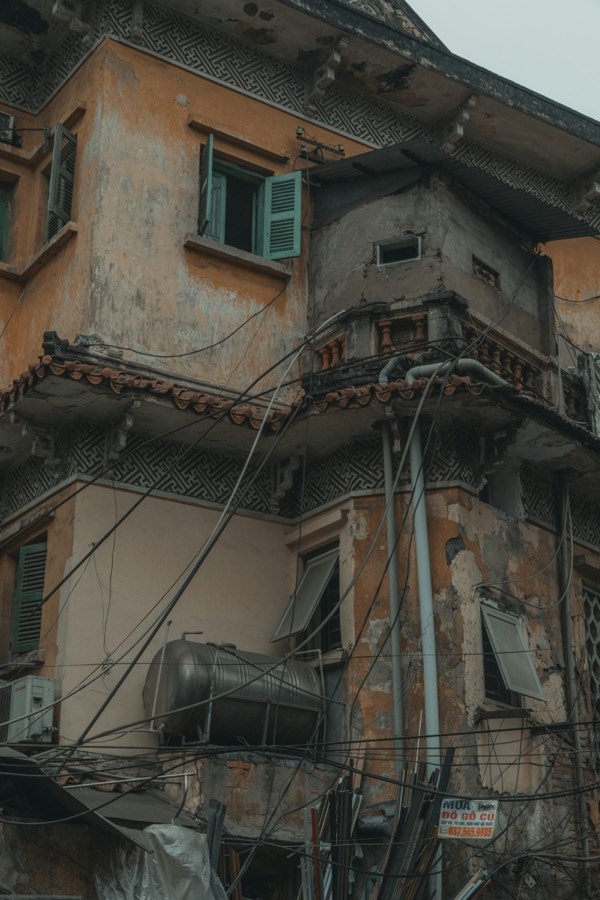
France occupied Hanoi in 1873 and established it as the capital of French Indochina (Vietnam, Laos, Cambodia) in 1887. The French Quarter that survives in central Hanoi - the wide tree-lined boulevards, the yellow plaster colonial buildings, the Opera House, the Metropole Hotel - was built between 1897 and 1914 under Governor-General Paul Doumer.
The French also built Hoan Kiem’s Ngoc Son Temple’s current bridge and surroundings, though the temple itself predates the colonial period. The Long Bien Bridge (1902, designed by Gustave Eiffel’s engineering firm) connected Hanoi to the north bank of the Red River.
Vietnamese resistance to French rule grew through the early 20th century. Ho Chi Minh, born Nguyen Sinh Cung in 1890, left Vietnam in 1911 and spent years in France, the Soviet Union, and China before returning to lead the Viet Minh independence movement. The August Revolution of 1945 declared Vietnamese independence; Ho Chi Minh read the Declaration of Independence in Ba Dinh Square on September 2, 1945 - the same square now fronts his mausoleum.
The First Indochina War and division (1946–1954)
France attempted to reassert control after World War II. The First Indochina War lasted eight years and ended with the French defeat at Dien Bien Phu in 1954. The Geneva Accords divided Vietnam at the 17th parallel into the communist north (Democratic Republic of Vietnam, capital Hanoi) and the non-communist south (Republic of Vietnam, capital Saigon).
The American War (Vietnam War) and Hanoi
The Second Indochina War - the Vietnam War in American terminology, the American War in Vietnamese - formally involved the United States from 1965 to 1975. Hanoi was bombed repeatedly: the Operation Rolling Thunder campaign (1965–1968) targeted infrastructure including the Long Bien Bridge (bombed 14 times; repaired each time), and the Christmas Bombing of December 1972 was the most intensive bombing of the war.
Hoa Lo Prison (Hanoi Hilton): Built by the French in 1896 to detain Vietnamese political prisoners. During the American War, US pilots shot down over North Vietnam were held here. The American prisoners nicknamed it the Hanoi Hilton. Senator John McCain was one of the most famous detainees, held from 1967 to 1973 after his A-4 Skyhawk was shot down over Truc Bach Lake (a plaque marks the spot).
The museum at Hoa Lo presents the French-era detention - the harsh conditions, the Vietnamese revolutionary prisoners - extensively, and the American POW section briefly and in a sanitised way (the museum emphasises the humane treatment the state claims was provided). The POWs’ own accounts describe significantly harder conditions. Both perspectives are worth knowing.
B-52 Lake (Huu Tiep Lake): In a residential area of Ngoc Ha, the wreckage of a B-52 shot down on December 27, 1972 - the Christmas Bombing campaign - still sits in a small lake. It is remarkable in its ordinariness: a pile of aircraft wreckage in the middle of a residential neighbourhood that has simply incorporated it into daily life.
Ho Chi Minh’s life and legacy
Ho Chi Minh led North Vietnam until his death in September 1969, six years before reunification. He is, by any measure, the most significant political figure in 20th-century Vietnamese history. His stilt house in Ba Dinh, where he lived and worked from 1958 to 1969, is preserved as a museum. His stated wish to be cremated was overridden by the Party; his embalmed body is displayed in the mausoleum and transported annually to Russia for maintenance.
The reverence in which he is held by most Vietnamese - not simply as party-mandated respect but as genuine national founding-father regard - takes visitors from outside the country by surprise. Understanding his biography is useful before visiting the mausoleum.
Reunification (1975) and Doi Moi
Saigon fell on April 30, 1975, reunifying Vietnam under Hanoi’s government. The north and south were formally unified in 1976 as the Socialist Republic of Vietnam. The immediate post-war decades were economically difficult.
The Doi Moi reforms of 1986 opened Vietnam to foreign investment and market economics while maintaining one-party political control. The economic growth since then has been substantial. Hanoi’s current skyline - the towers of Ba Dinh and Cau Giay - dates mainly from the post-2000 construction boom.
To get context before exploring these sites, joining a guided history tour in Hanoi covers the Old Quarter, Hoa Lo Prison, and the Ba Dinh complex with local guides who can explain the political and cultural context behind what you’re seeing.
More in Hanoi
- Best Cafes to Work From in Hanoi 2026: Wifi, Coffee and Space
- Best Hostels in Hanoi 2026: Old Quarter Budget Stays
- Best Hotels in Hanoi 2026: From Boutique to Luxury
- Best Restaurants in Hanoi 2026: Where Locals and Visitors Eat
- Hanoi Coffee Guide 2026: Egg Coffee, Phin Drip and Cafe Culture
- Day Trips from Hanoi 2026: Ninh Binh, Ha Long Bay and More
- Hanoi Food Guide 2026: What to Eat and Where to Find It
- Getting Around Hanoi 2026: Grab, Motorbikes and Public Transport
- Hanoi Nightlife 2026: Beer Streets, Rooftops and Jazz
- Things to Do in Hanoi 2026: Old Quarter, Lakes and Day Trips
- Vegan Food in Hanoi 2026: Buddhist Restaurants and Plant-Based Options
- Best Hotels in Hanoi 2026: Best Neighbourhoods