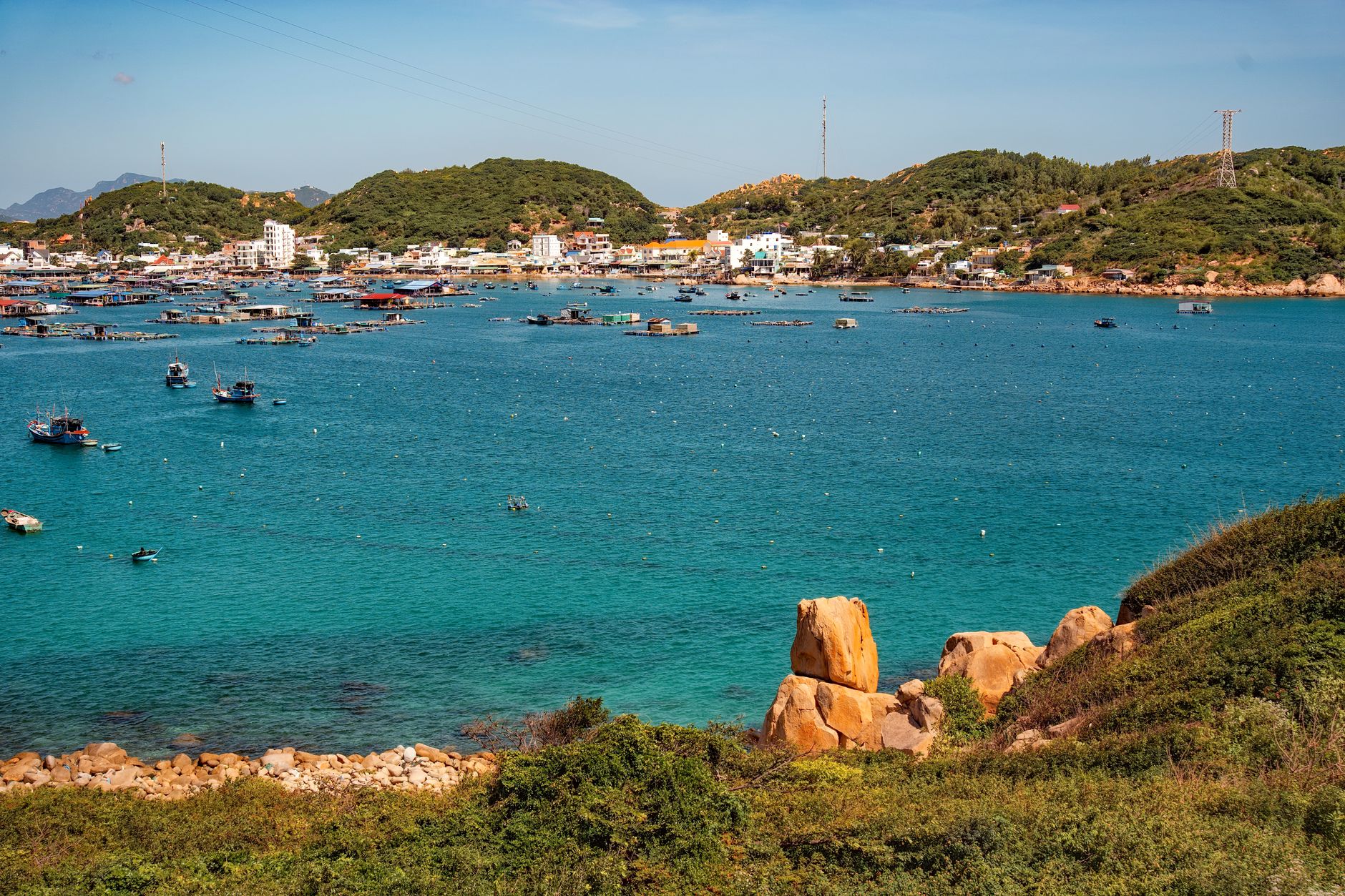
Quy Nhon sits on a horseshoe bay on Vietnam’s south-central coast, with an active fishing fleet, a working fish market, and a local food culture that has remained largely under the tourist radar until recently. The city’s best dishes are hyper-local: bun sua (jellyfish noodle soup) is barely found outside Binh Dinh province, and the banh it dumplings here differ from versions made elsewhere in central Vietnam. The seafood is among the freshest and cheapest on the Vietnamese coast.
Bun Sua (jellyfish noodle soup)
The dish that identifies a Quy Nhon food scene unlike anywhere else in Vietnam. Fresh jellyfish (sua bien) is cleaned, cut into strips, and served in a clear broth over rice vermicelli noodles. The jellyfish has almost no flavour of its own - its value is textural: dense, chewy, and slightly crunchy in a way that nothing else in Vietnamese cooking replicates.
The broth is made from pork or fish bones with lemongrass and fish sauce. The bowl arrives topped with spring onion, fried shallots, and sometimes small shrimp. You add your own chilli and lime from the condiment tray on the table.
Bun sua is almost exclusively a Quy Nhon product. The jellyfish used are harvested from the sea around Binh Dinh province and are seasonal - most abundant from roughly March to July.
Where to eat it: Morning street stalls and market vendors (05:30-10:00) are the best source. The area around Quy Nhon’s central market (Cho Lon, on Le Loi street) has several bun sua specialists. 25,000-45,000 VND ($1-1.80) per bowl.
A note on texture: If you have never eaten jellyfish before, the texture is the surprise - it does not fall apart in the mouth but resists the bite slightly. Some people find this off-putting; most find it interesting. The broth quality is what elevates a good bun sua from a mediocre one.
Banh It Tran (steamed sticky rice dumplings)
Small, dense dumplings made from glutinous rice flour and steamed in banana leaf parcels. The Quy Nhon version (banh it tran, or “naked banh it” - without a full banana leaf wrapping) differs from versions made elsewhere in central Vietnam by being served directly without the leaf and eaten with a dipping sauce of fish sauce, lime, garlic, and chilli.
The filling is mung bean paste mixed with dried shrimp and sometimes fragments of fatty pork. The outer layer has the slight chewiness of cooked glutinous rice flour.
Sold at morning markets and by street vendors throughout the day. 5,000-10,000 VND ($0.20-0.40) per dumpling. They are small - budget 5-7 per person as a snack.
Sea Urchin (Nhim Bien)
Sea urchin roe from the waters around Quy Nhon and the offshore islands is a local delicacy. The roe (the edible part) is orange and intensely oceanic in flavour - briny, slightly sweet, and rich. Fresh urchin is at its best eaten within hours of collection.
How it is served in Quy Nhon:
- Fresh out of the shell with lime and salt (most common, lets the urchin speak for itself)
- With banh trang crackers as a vehicle
- In soup: steamed with egg in a clear broth
- Occasionally in a rice porridge (chao nhim bien) at specialist restaurants
Sea urchin is highly seasonal. The best quality is found from October to March when the urchins are most roe-laden. Prices fluctuate accordingly: 50,000-150,000 VND ($2-6) per urchin at restaurants. At the central fish market early in the morning, prices are lower if you are willing to eat at the market itself.
Where to buy: The Quy Nhon fish market (Cho Ca Lon, near the harbour) has fresh urchin on ice from early morning. The seafood restaurants along Xuan Dieu beach road serve it prepared.
Mantis Shrimp (Tom Tich)
Mantis shrimp (known locally as tom tich or tom lau) are found throughout the South China Sea coast but are particularly good around Quy Nhon due to the rocky seabed conditions offshore. They are sweet, firm, and best eaten simply.
Common preparations:
- Steamed with ginger and served with lime salt for dipping
- Grilled over charcoal with light seasoning
- Stir-fried with garlic, butter, and chilli (tom tich xao toi ot)
- Salt-baked (rang muoi) - a dry-heat preparation that concentrates the sweetness
Price: 120,000-220,000 VND ($4.80-8.80) per kg at the fish market; 150,000-300,000 VND ($6-12) per kg at restaurants.
Banh Hoi Chao Long (fine noodles with offal soup)
A central Vietnamese breakfast dish. Banh hoi are extremely fine rice noodles - much thinner than standard vermicelli - layered in a flat mat and typically eaten with grilled pork or offal. In Quy Nhon the most common pairing is chao long - offal soup made from pork intestine, liver, and stomach in a light, slightly sour broth.
The combination sounds challenging but works: the delicate noodles against the strong broth, with fried shallots and fresh herbs adding lightness. This is breakfast food, served from around 06:00 at stalls throughout the city.
25,000-45,000 VND ($1-1.80) per serving at street stalls.
Banh Xeo (sizzling pancake)
Central Vietnam’s crispy pancake is found throughout the region but the Quy Nhon version tends to be smaller and crisper than the Da Nang iteration, with a higher proportion of filling relative to the batter. The standard filling is shrimp, pork belly, and bean sprouts; some stalls add squid pieces.
Eaten by wrapping pieces in rice paper or lettuce with herbs, dipping in nuoc cham sauce. 35,000-65,000 VND ($1.40-2.60) per pancake at street stalls and small restaurants.
Seafood along Xuan Dieu Beach Road
The beach road (Xuan Dieu, running along Quy Nhon Bay) has the highest concentration of seafood restaurants in the city. Most display live or fresh tanks and ice-packed displays of the day’s catch at the entrance.
How ordering works: Choose your seafood by the piece or by kg (most items are priced by weight), then specify the cooking method. The restaurant will confirm the weight and price before cooking. Keep the receipt. This is the standard system and the restaurants are used to pointing at menu items for non-Vietnamese speakers.
A full seafood dinner for two with two species (mantis shrimp and one fish, for example) plus rice and beer runs 300,000-600,000 VND ($12-24). The beach road restaurants are moderately priced - not the cheapest in the city (the fish market area is cheaper) but not tourist-inflated pricing.
Best value: Arrive for an early dinner (17:00-18:30) when the day’s catch is freshest. The restaurants fill from 18:30 onward on weekends.
Local drinks
Ruou can: Rice wine drunk communally through bamboo straws - a Bahnar and Cham H’roi minority tradition from the surrounding highlands that occasionally appears at restaurants serving highland cuisine in Quy Nhon.
Nuoc mia (sugarcane juice): Pressed fresh at street stalls throughout the city. 10,000-20,000 VND ($0.40-0.80) per glass over ice. Essential in the Quy Nhon heat.
Bia hoi: Fresh draught beer is cheap in Quy Nhon. 8,000-15,000 VND ($0.32-0.60) per glass at bia hoi stalls in the market area.
Useful links:
More in Quy Nhon
- Quy Nhon Beaches 2026: Ky Co, Eo Gio and the Best Swimming Spots
- Best Hostels in Quy Nhon 2026: Budget Stays Near the Beach
- Best Hotels in Quy Nhon 2026: Beach Resorts and City Options
- Best Restaurants in Quy Nhon 2026: Seafood, Banh It and Local Dishes
- Day Trips from Quy Nhon 2026: Ky Co Island, Eo Gio and Cham Towers
- Getting to Quy Nhon 2026: Flights, Train and Bus Options
- Things to Do in Quy Nhon 2026: Beaches, Cham Ruins and Seafood