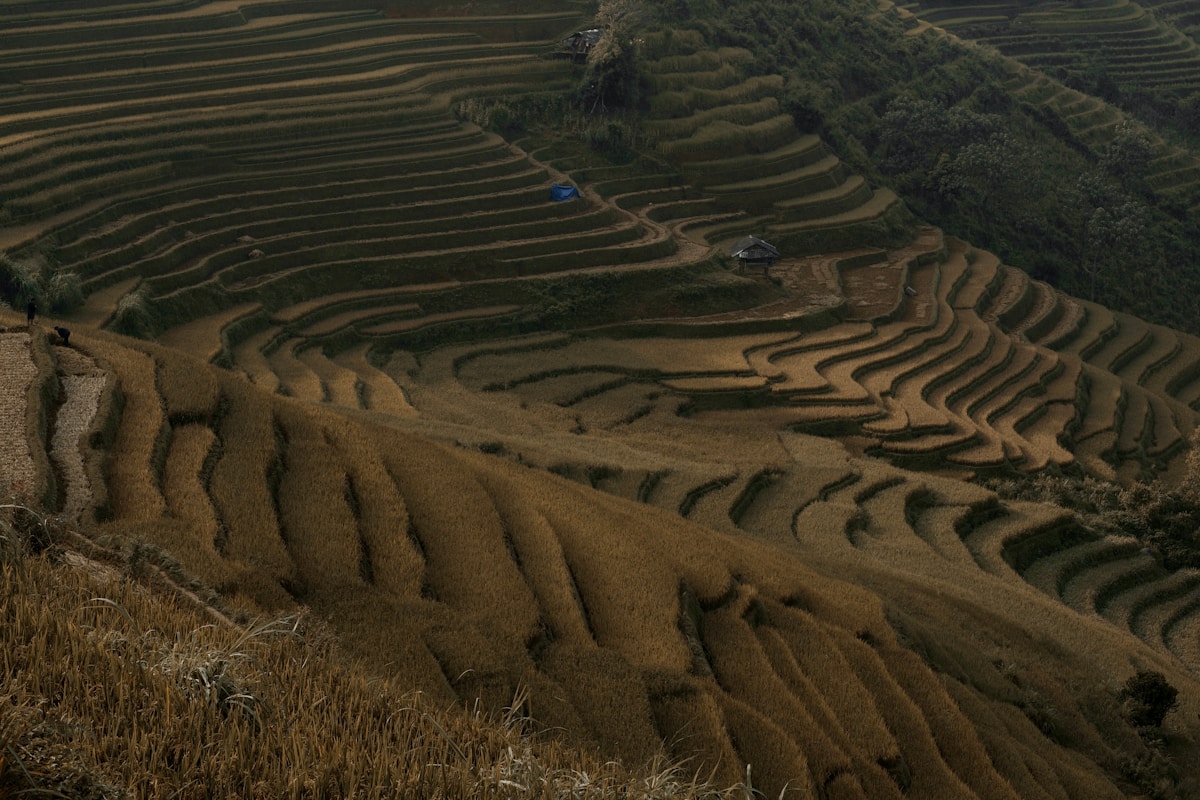
Mu Cang Chai 2026: Vietnam's Best Rice Terrace District
Mu Cang Chai travel guide covering Vietnam's most dramatic rice terraces, harvest season timing, Black Hmong villages, and transport from Hanoi.
Guides for Mu Cang Chai
Mu Cang Chai is the rice terrace district of Yen Bai province, 280km northwest of Hanoi at 1,000m elevation. The terraced hillsides here are among the most visually spectacular in Vietnam - UNESCO World Heritage-listed cultural landscapes carved into steep mountain terrain by the Black Hmong over centuries.
Why Mu Cang Chai is different from Sapa
Both destinations have rice terraces and Hmong minority communities. The difference is development. Sapa has a large tourist town with cable cars, luxury hotels, and group tour infrastructure. Mu Cang Chai has very little of this. The district town of Mu Cang Chai is small and functional - no boutique hotels, no tourist cafes, no souvenir market. Visitors stay in basic guesthouses or local homestays.
The terraces at Mu Cang Chai are frequently described as more dramatic than Sapa’s - the gradient is steeper, the terracing more intricate, and the scale more overwhelming. The La Pan Tan, De Xu Phinh, and Che Cu Nha communes are the three most visually concentrated areas.
Best time to visit
September (harvest season): The annual rice harvest in late September transforms the terraces from green to gold to stubble in approximately 3 weeks. This is the peak photography window. The exact timing shifts by 1–2 weeks depending on the year - check locally for current conditions before travelling. Tourist numbers peak during this window; guesthouses in the district town fill up.
May–June (water season): Before planting, the terraces are flooded with water - reflective mirrors of sky and mountain. Equally spectacular but less well-known. Far fewer visitors.
Other months: The terraces are green and the landscape is beautiful year-round, but without the gold of harvest or the mirror of flooding, the visual impact is lower.
The communes
Three main terrace concentrations:
La Pan Tan: 9km from the district town. The most commonly photographed terrace area. High density of terracing on both sides of the valley road.
De Xu Phinh: 17km from town. Larger-scale terracing on steeper slopes. Slightly further but quieter.
Che Cu Nha: 10km from town. Good terracing with mountain backdrop.
All three are accessible by motorbike from the district town. Motorbike hire: ₫150,000–200,000 ($6–8) per day.
Costs
The district town has basic guesthouses at ₫150,000–350,000 ($6–14) per room. Homestays in the terraced villages: ₫200,000–300,000 ($8–12) per person including meals. Food from local restaurants: ₫40,000–80,000 ($1.60–3.20) per dish. Mu Cang Chai is genuinely cheap - the lack of tourism infrastructure keeps prices low.
Who comes here
Photography travellers - the terrace landscape is a significant draw for landscape photographers from Vietnam and internationally. Independent travellers on the northwest Vietnam circuit who have already done Sapa and want something less developed. Motorbike riders on the northwest loop (the road to Mu Cang Chai from Tu Le Pass is one of the most scenic in Vietnam). For guided tours from Hanoi during harvest season, browse Vietnam northwest circuit tours.
Getting to Mu Cang Chai
From Hanoi by bus: Hanoi to Mu Cang Chai town takes 6–7 hours. The most direct option is the overnight sleeper bus (departures from My Dinh Bus Station at approximately 22:00, arriving in the early morning). Day buses also run, departing around 06:00 and arriving by 13:00–14:00. Cost: ₫200,000–300,000 ($8–12) depending on the operator and bus type.
From Hanoi by motorbike: The standard northwest loop route goes Hanoi → Hoa Binh → Son La → Dien Bien → Sapa, with Mu Cang Chai typically approached from the north via the Khau Pha Pass road from Tu Le. The total distance from Hanoi to Mu Cang Chai on this route is approximately 350km (2 full days of riding). The pass road from Tu Le is considered one of the best riding sections in northern Vietnam.
Local food and costs: The district town has several local restaurants and small guesthouses on the main street. A full meal of rice with stir-fried vegetables and pork costs ₫40,000–70,000 ($1.60–2.80). Fresh pho at the market opens from 06:00 at ₫35,000–50,000 ($1.40–2) per bowl. The town has one ATM (Agribank) — withdraw cash before arriving, as it occasionally runs out during peak season.
Where to stay
Mu Cang Chai Ecolodge: The most comfortable guesthouse in the district town, with private rooms and hot water. Approximately ₫250,000–550,000 ($10–22) per room as of 2026. Good breakfast available.
Phu Yen Homestay (La Pan Tan commune): A homestay located within the terraced hillsides rather than the district town. Approximately ₫200,000–300,000 ($8–12) per person including dinner and breakfast. Communal sleeping on padded mats, cold water bathroom. The terrace views from the sleeping area are the main draw.
Basic guesthouses (district town): Multiple options on the main street at ₫150,000–300,000 ($6–12) per room as of 2026. Facilities are minimal — squat toilets, cold water, thin walls. Functional for one or two nights but not comfortable for an extended stay.
During harvest season (September): All accommodation fills up. Book at least 2–3 weeks ahead. Prices increase 30–50% above standard rates.
Practical notes
ATM: The district town has a single Agribank ATM on the main street. Withdraw cash before arriving — it occasionally runs out during harvest season when visitor numbers spike. No other banking facilities in the district.
Viewpoint timing: La Pan Tan viewpoint (9km from town) is best visited at 06:30–08:00 for morning light on the terraces. De Xu Phinh (17km) catches different light — afternoon is better for the westward-facing slopes. A motorbike covers both in one day: depart at 06:00, La Pan Tan first, De Xu Phinh after lunch, return by 17:00.
Local guide: Hiring a local guide costs approximately ₫300,000–500,000 ($12–20) per day as of 2026. Recommended for finding the best vantage points at golden hour, which are not always obvious from the road. Ask at your guesthouse for a guide connection.
Weather: At 1,000m elevation, mornings and evenings in September–October can be cold (12–15°C) despite warm midday temperatures. Bring a light jacket. The harvest season coincides with occasional afternoon mist, which can obscure the terraces entirely — golden hour windows may be short.
More in Mu Cang Chai
- Things to Do in Mu Cang Chai
- Mu Cang Chai Rice Terraces Guide
- Where to Stay in Mu Cang Chai
- Best Hostels in Mu Cang Chai
- Getting to Mu Cang Chai
- Best Time to Visit Mu Cang Chai
Nearby destinations
Plan your trip
Planning to visit? Browse hotels in Mu Cang Chai — free cancellation on most bookings.
Book an experience
Top experiences in Mu Cang Chai
Explore the best tours and activities in Mu Cang Chai , with instant confirmation and free cancellation on most bookings.
Frequently Asked Questions
- How is Mu Cang Chai different from Sapa?
- Sapa has a large tourist town with cable cars, luxury hotels, and group tour infrastructure. Mu Cang Chai has very little of this - a small functional district town with basic guesthouses and no souvenir markets. The terraces are frequently described as more dramatic with steeper gradients and more intricate terracing.
- Are the Mu Cang Chai rice terraces UNESCO listed?
- They are listed as a National Scenic Heritage site by Vietnam. The terraces cover 2,200 hectares across the La Pan Tan, De Xu Phinh, and Che Cu Nha communes, carved into steep mountain terrain by Black Hmong communities over centuries.
- How much does it cost to visit Mu Cang Chai?
- Mu Cang Chai is genuinely cheap. Guesthouses cost 150,000-350,000 VND ($6-14) per room. Homestays with meals cost 200,000-300,000 VND ($8-12) per person. Local restaurant meals cost 40,000-80,000 VND ($1.60-3.20).
- Who typically visits Mu Cang Chai?
- Photography travellers attracted by the terrace landscape, independent travellers on the northwest Vietnam circuit who have done Sapa and want something less developed, and motorbike riders on the northwest loop.