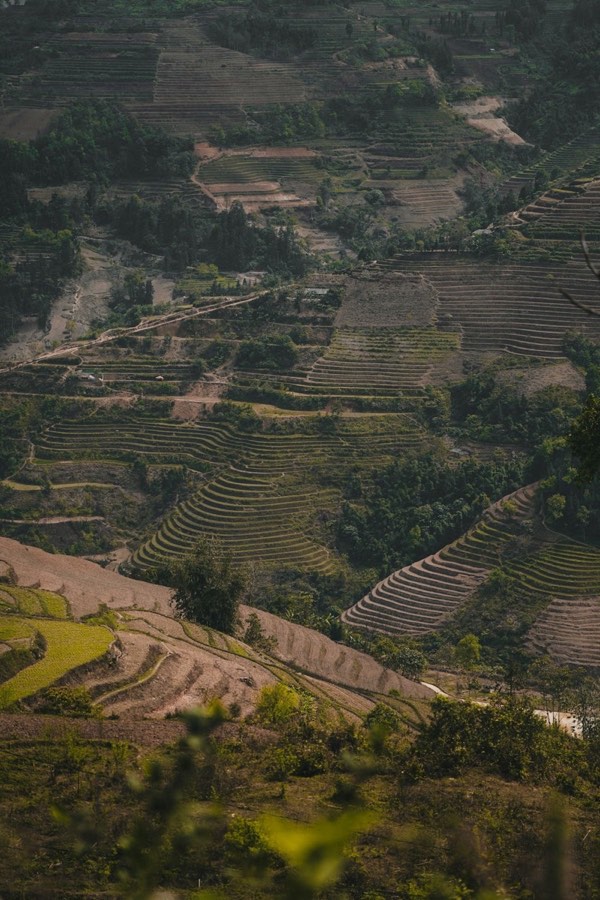
Mu Cang Chai has no hostels. It’s a remote mountain district in Yen Bai province, around 280 km northwest of Hanoi, and the budget accommodation infrastructure reflects that remoteness. What exists is functional and honest - guesthouses in the district town, basic homestays in terrace villages - but don’t arrive expecting anything resembling a Hanoi hostel.
Most visitors come specifically for the rice terraces, concentrated around the villages of La Pan Tan, Che Cu Nha, and De Xu Phinh. The timing of that visit matters enormously: the terraces are at their best during the transplanting season (late May–June, when the paddies are flooded and reflecting the sky) and the harvest season (late September–October, when the fields turn gold). Outside these windows, the landscape is greener but less dramatic.
Guesthouses in the district town
Mu Cang Chai town (the administrative centre) sits on Highway 32 and has a handful of guesthouses offering private rooms. These are the most straightforward budget option:
Rate: ₫150,000–300,000 per room per night ($6–12), without meals. At the lower end you get a fan room with a basic bathroom; mid-range guesthouses have air conditioning and hot water.
The town itself is a small Vietnamese market town - a morning market, a few com binh dan (local lunch spots), and not much else. It’s a base for getting to the terrace viewpoints, not a destination in itself. The guesthouses here are practical rather than characterful.
Finding specific properties: Agoda lists a small number; search “Mu Cang Chai” and filter to lowest price. Availability during peak terrace season (late September to early October in particular) goes quickly - book several weeks ahead. During off-peak periods, walk-in rates are standard.
Terrace village homestays: the better option
For photographers, trekkers, and anyone who wants to be in the terraces at dawn and dusk, a homestay in one of the terrace villages is the right choice.
Black Hmong families in La Pan Tan and surrounding villages host travellers, typically in simple wooden or concrete houses with basic bedrooms or shared sleeping areas. The experience is less formalised than the White Thai homestays of Mai Chau - fewer families have set up specifically for tourists, so it can feel more like genuinely staying in someone’s home.
Cost: ₫200,000–300,000 per person including dinner and breakfast ($8–12). The food is simple: rice, vegetables from the fields, sometimes chicken or pork. Reliable enough, and the inclusion matters because food options in the villages are minimal.
What to expect: Squat toilets are standard in village homestays. Showers are cold water. Sleeping is on a mat or a basic bed. Mobile coverage is patchy in the villages. Bring a torch - village paths at night are unlit. This is basic infrastructure honestly. The payoff is watching sunrise over the terraces without a two-hour drive from town.
Arranging village homestays: some Hanoi-based tour operators include homestay accommodation in Mu Cang Chai packages. Alternatively, guesthouse owners in the district town often have contacts in terrace villages. It’s not easy to arrange fully independently without Vietnamese language skills, though more families have started accepting walk-in travellers during peak season.
De Xu Phinh and Che Cu Nha communes
Most visitors head to La Pan Tan because it’s the closest terrace commune to the district town (around 10km). De Xu Phinh (17km from town) and Che Cu Nha (14km) are quieter and see fewer visitors, which makes the homestay experience more genuine and prices more negotiable. During peak season, La Pan Tan fills first - if you’re arriving without a booking, De Xu Phinh is worth trying.
The road connecting all three communes is paved and manageable on a semi-automatic motorbike. A hired driver for a day covering all three viewpoints costs approximately ₫400,000–600,000 ($16–24) depending on distance and negotiation.
Tu Le: the alternative base
Tu Le valley, 24km south of Mu Cang Chai town on Highway 32, has its own accommodation (a small cluster of guesthouses and homestays) and its own terraces. Muong sticky rice cooked in Tu Le is notably good. Staying here and day-tripping north to Mu Cang Chai by motorbike (around 45 minutes) means you get the best of both valleys without fighting for accommodation at peak season. During harvest season, Tu Le guesthouses can be easier to book than Mu Cang Chai options. Rates are similar: ₫150,000–250,000 ($6–10) for a guesthouse room.
Booking during harvest season
The rice terrace harvest runs from late September through mid-October, with the peak colour window of roughly 10 days being impossible to predict exactly - it varies year to year based on planting dates and weather. The most reliable approach:
- Book accommodation in early September for a late September stay and plan to be flexible on exact dates
- The district town guesthouses are easiest to book via Agoda; filter to lowest price
- Village homestays have no online booking - use your district town guesthouse as an intermediary to contact families in La Pan Tan
- If you arrive and everywhere is full in Mu Cang Chai town, Tu Le 24km south is a realistic backup with its own terrace scenery
Photography homestays
The main reason to stay in a terrace village rather than the district town is access to dawn and dusk light. The terraces photograph best in the first and last 90 minutes of daylight. Staying in the village means you walk 10 minutes to a viewpoint; staying in town means a 30-40 minute drive, often in darkness. For serious photographers, a village homestay in La Pan Tan or De Xu Phinh is not optional - the light is the reason to be there.
The best harvest viewpoints - the Mu Cang Chai Terrace Scenic Area at La Pan Tan, the De Xu Phinh valley overlook, and the Che Cu Nha zigzag road - are all within reach of village homestays on foot or a short motorbike ride.
Practical notes
- The drive from Hanoi takes 5–6 hours on winding mountain roads; buses from My Dinh station serve the route (₫120,000–180,000)
- A motorbike or hired driver is essential for getting from the town to the terrace viewpoints - the best spots are 10–20 km from the centre
- Peak season (October harvest) brings significantly more visitors; accommodation fills and prices rise
- Cold nights year-round at this altitude (around 1,000m in the valleys, higher in villages) - pack a warm layer regardless of when you visit
For a full overview of the rice terraces, seasonal timing, and how to arrange transport within the district, see the Mu Cang Chai guide.
Useful links: