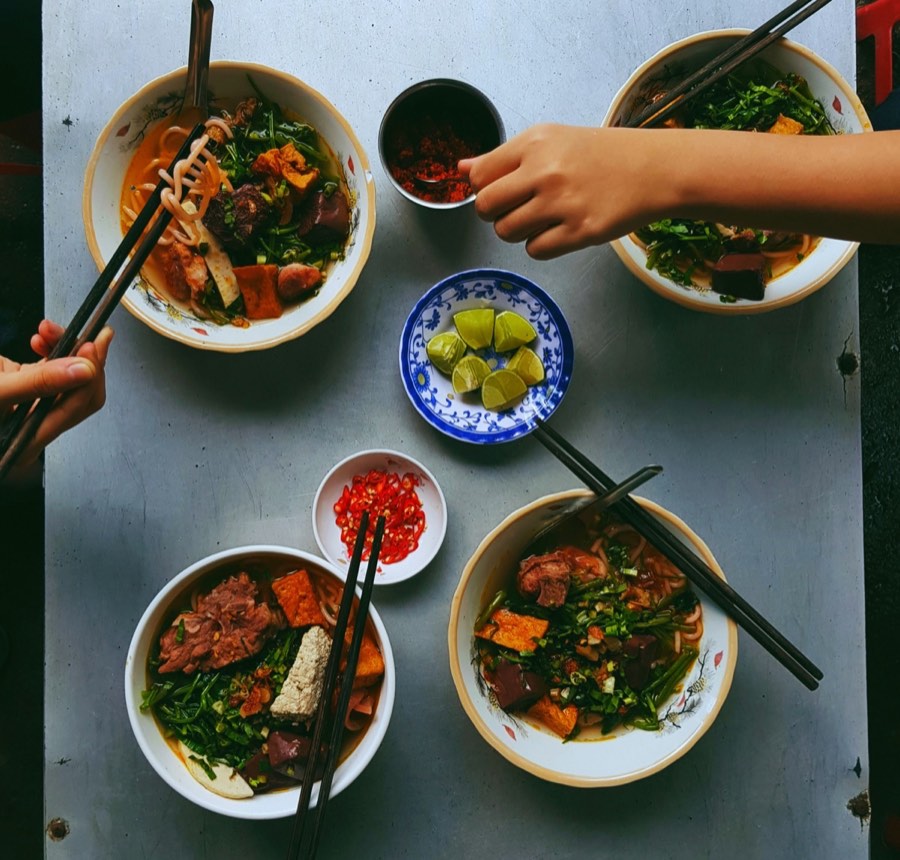
Vietnam is not the first destination that comes to mind for plant-based travel, but it should be. A strong Buddhist tradition means that vegetarian cooking - called chay - has deep roots across the country. Hundreds of dedicated chay restaurants operate in every major city. Monks have been perfecting meat-free pho, banh mi, and rice dishes for centuries. With a little knowledge of what to look for and a few key phrases, eating vegan or vegetarian in Vietnam is genuinely straightforward.
This guide covers everything you need: the core dishes, the restaurant culture, the phrases that actually get results, and specific recommendations for Hanoi, Ho Chi Minh City, Hoi An, and Da Nang.
Understanding Chay Culture
The word chay (pronounced like “chai” without the diphthong) covers vegetarian and vegan cooking in a Buddhist context. Unlike Western vegetarianism, Vietnamese chay often also excludes garlic, onion, leeks, and chives - the five pungent vegetables associated with desire in Buddhist tradition. Some chay dishes therefore taste quite different from their meat-filled counterparts.
Buddhist practice drives a lot of the chay market. Many Vietnamese observe vegetarian days on the 1st and 15th of each lunar month (the new moon and full moon). On these days, chay restaurants across the country are packed and can run through their stock by early afternoon. If you happen to be travelling around these dates, arrive early.
Chay food is also not always vegan by Western standards. Eggs and dairy occasionally appear, though less commonly than in Western vegetarian cooking. If you follow a strict vegan diet, the phrase “khong co trung va sua” (no eggs and dairy) is useful.
Key Dishes to Know
Pho Chay
Standard pho uses beef or chicken stock, but pho chay replaces the broth with a vegetable-based stock - typically roasted vegetables, ginger, star anise, and dried mushrooms. The result is lighter but still deeply flavoured. Tofu, mushrooms, and fresh herbs sit in place of meat. Find it at dedicated chay restaurants and some mainstream pho shops in tourist areas.
Banh Mi Chay
The baguette sandwich made plant-based. Pate and cold cuts are swapped for tofu, mock meat made from soy or wheat gluten, pickled daikon and carrots, cucumber, fresh coriander, and chilli. Some versions are fully vegan; others include egg-based mayo. Ask to be sure.
Com Chay (Vegetarian Rice Plates)
These are the backbone of the chay diet - a plate of rice with a selection of vegetable-based dishes. Expect braised tofu, stir-fried greens, pickled vegetables, and mushroom-based dishes. Usually priced between 40,000 and 70,000 VND (approximately USD 1.50–3 as of 2026). Com chay restaurants are often marked with a yellow sign and the word Com Chay in red text.
Bun Chay
Vermicelli noodles in vegetable broth, topped with tofu, mushrooms, and fresh herbs. A lighter option than pho and widely available at chay restaurants.
Bun Bo Hue Chay
The vegetarian version of the spicy Hue noodle soup - a chay adaptation that captures the lemongrass and chilli heat of the original using mushrooms and tofu instead of beef shank and pork.
Goi Cuon Chay (Vegetarian Fresh Spring Rolls)
Rice paper rolls filled with vermicelli, tofu, fresh herbs, lettuce, and dipping sauce. One of the easiest vegan dishes to find at regular restaurants, not just chay ones.
Mock Meat Dishes
Vietnamese chay cooking has sophisticated mock meat traditions. You’ll find tofu sculpted to resemble roasted pork, gluten-based “chicken,” and soy-based “beef” prepared with impressive skill. Some chay restaurants dedicate entire menus to these dishes.
Useful Vietnamese Phrases
Knowing a few phrases goes a long way, especially at street stalls and non-tourist restaurants.
| Phrase | Pronunciation | Meaning |
|---|---|---|
| Tôi ăn chay | Toy an chay | I eat vegetarian |
| Có món chay không? | Koh mon chay khong | Do you have vegetarian dishes? |
| Không có thịt | Khong koh tit | No meat |
| Không có cá | Khong koh kah | No fish |
| Không có nước mắm | Khong koh nuk mahm | No fish sauce |
| Không có trứng | Khong koh chung | No eggs |
| Không có sữa | Khong koh soo-ah | No dairy |
| Tôi bị dị ứng | Toy bee dee ung | I have an allergy |
The most practical combination for ordering at non-chay restaurants: “Tôi ăn chay, không có thịt, không có cá, không có nước mắm” (I eat vegetarian - no meat, no fish, no fish sauce).
Be aware that fish sauce and shrimp paste appear in many Vietnamese dishes as seasoning rather than a main ingredient, so they may not be visible on menus or mentioned by staff. At dedicated chay restaurants, these are never used. At non-chay restaurants, confirm explicitly.
City-by-City Recommendations
Hanoi
Hanoi has a strong chay scene concentrated in the Old Quarter and near Buddhist temples. The city’s chay restaurants tend to be casual, inexpensive, and packed at lunch.
What to look for: Streets around Hoan Kiem Lake have multiple chay restaurants within a few blocks. Look for the yellow-and-red signage. Com chay lunch sets are typically available 11am–2pm only.
Standout dishes in Hanoi: Pho chay is particularly good here - the northern style is clear-brothed and clean-tasting. Hanoi street stalls also do excellent banh mi chay, often from a cart rather than a permanent shop.
Our guide to Hanoi restaurants covers the broader dining scene including chay-friendly spots.
Ho Chi Minh City (Saigon)
HCMC has the most developed chay restaurant scene in Vietnam. The District 3 and District 10 areas have concentrations of chay restaurants catering to both Buddhist practitioners and the growing health-food market. Some establishments here run upscale chay fine dining, while the majority are simple rice-and-tofu lunch counters.
What to look for: Pham Viet Chanh Street in Binh Thanh District has several chay spots. District 3 around Vo Thi Sau Street is another reliable area. The Ben Thanh Market area has a few chay stalls.
Southern style difference: HCMC chay food tends to be sweeter and more abundant with mock meat than northern chay. Expect more elaborate presentations and a wider variety of tofu preparations.
See our Ho Chi Minh City restaurant guide for the full dining breakdown.
Hoi An
Hoi An is arguably the best city in Vietnam for plant-based travellers. Its tourist infrastructure means most restaurants have clear English menus with vegetarian options marked. Several spots in the Ancient Town specifically market themselves to vegan travellers, with dishes like cao lau chay (vegetarian version of the local noodle dish) and white rose dumplings with tofu filling.
What to look for: Nguyen Thi Minh Khai Street and the lanes off the Thu Bon River have the highest concentration of vegetarian-friendly restaurants. The covered market also has stalls selling com chay at very low prices.
Cooking class option: Hoi An’s cooking classes frequently accommodate vegetarian and vegan requests - worth checking before booking. Our Hoi An cooking class guide has details.
Da Nang
Da Nang’s chay scene is less tourist-focused than Hoi An but more genuine for that. The city has a substantial Buddhist population, which means chay restaurants operate around temples and in residential neighbourhoods rather than along tourist strips.
What to look for: Restaurants near Linh Ung Pagoda on Son Tra Peninsula often serve chay food. Nguyen Chi Thanh Street in the city centre has several reliable lunch spots.
Practical note: Da Nang is a useful base for day trips to Hoi An and the Marble Mountains, both of which have stronger chay options if you’re struggling to find what you need in Da Nang itself.
Navigating Non-Chay Restaurants
At mainstream Vietnamese restaurants that don’t specialize in chay, you have some reliable options:
Always safe to order:
- Fresh spring rolls (goi cuon) - usually vegan if you confirm no shrimp
- Stir-fried morning glory (rau muong xao) - watch for garlic/fish sauce
- Congee (chao) with tofu or plain
- Steamed rice (com trang)
Dishes that sound vegetarian but often aren’t:
- Pho - stock is almost always meat-based at non-chay restaurants
- Fried rice (com rang) - often contains egg and sometimes meat
- Vegetable soups - frequently use pork or chicken bone stock
The safest approach at non-chay restaurants is to stick to recognizably plant-based dishes and ask explicitly about fish sauce. Many kitchen staff will find a way to accommodate a clear, simple request.
Apps and Tools
HappyCow is the most reliable resource for finding vegetarian and vegan restaurants in Vietnam. It works offline and covers smaller cities and beach towns where options are sparse. Download it before you travel.
For phrase translation in the moment, Google Translate with offline Vietnamese downloaded handles the basics. The camera translation feature is useful for menus with no English.
Buddhist Temple Restaurants
Many Buddhist temples in Vietnam operate small canteen-style restaurants on their grounds, open to the public. These are almost always fully vegan (no eggs, no dairy, no pungent vegetables), extremely inexpensive - often 20,000–40,000 VND (approximately USD 1–2 as of 2026) for a full meal - and worth seeking out as a cultural experience as much as a practical option.
Temple kitchen hours are usually limited to lunchtime (11am–1pm). Arrive early, as food runs out quickly and the temples don’t operate as commercial restaurants with rapid restocking.
Notable temple restaurants include those at Giac Lam Pagoda in HCMC and various temples in Hoi An’s Ancient Town.
What to Read Next
For broader context on Vietnamese food culture, our Vietnamese street food guide covers the must-eat dishes across the country, including which ones are most naturally plant-based.
If you’re planning your route around food and culture, our 2-week Vietnam itinerary builds in time in all four cities covered above.
For key phrases beyond food, our basic Vietnamese phrases guide covers transport, bargaining, and accommodation conversations.
To book food tours, cooking classes, and cultural experiences with dietary requirements in mind, browse Vietnam tours on GetYourGuide.
Plan Your Trip
✈️ Book your flights to Vietnam 🛡️ Get travel insurance 📱 Stay connected with an eSIM 🚗 Rent a car