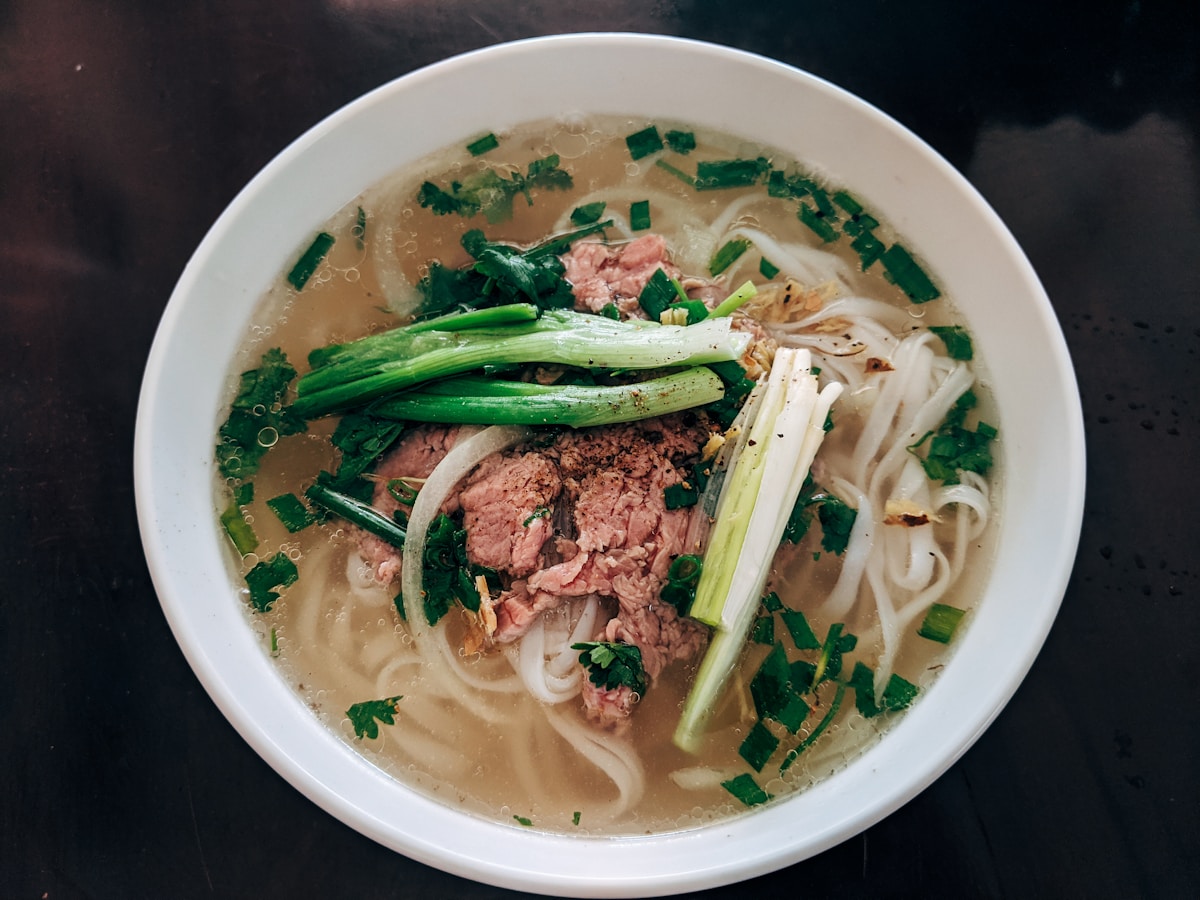
Vietnamese street food is cooked and eaten on the pavement, at plastic stools a few centimetres off the ground, from stalls that have sometimes operated in the same spot for generations. The best street meals in Hanoi and Ho Chi Minh City cost between VND 30,000 and VND 80,000 (approximately $1.20–$3.20 as of 2026). This guide covers the six dishes that define Vietnamese street food culture - what they are, where the regional differences lie, and the specific stalls worth seeking out.
For a broader overview of Vietnamese cuisine across all dishes and cooking styles, see our essential Vietnamese dishes guide.
Pho - The National Noodle Soup
Pho is a rice-noodle soup built on a broth simmered for hours from beef bones (pho bo) or chicken bones (pho ga) with charred ginger, star anise, cinnamon, and cloves. The result is fragrant and deeply savoury. Noodles go in the bowl first, then protein - rare beef slices, well-done brisket, or meatballs in the case of pho bo - and then the hot broth is poured over to finish the cooking.
North vs south: genuinely different dishes. Hanoi pho uses a cleaner, less sweet broth and wider, softer noodles. The only condiments offered are a wedge of lime and fresh chilli slices. Southern pho (Saigon style) is sweeter and arrives with a plate of bean sprouts, Thai basil, and both hoisin sauce and sriracha on the side. Purists from both cities argue loudly; the honest answer is that both are excellent and both are worth eating.
Where to eat pho in Hanoi:
- Pho Gia Truyen (49 Bat Dan, Hoan Kiem) - The most-cited pho shop in Hanoi. Cash only, plastic stools, queues at 7am. Pho bo with brisket and rare beef runs approximately VND 60,000–75,000 ($2.40–$3.00 as of 2026). Open 6am–10pm, often sells out before noon.
- Pho Bat Dan (49 Bat Dan area) - The same street has several competing shops; all are good. Go early.
- Pho Thin (13 Lo Duc, Hai Ba Trung) - Famous for a different Hanoi variant: the beef is stir-fried briefly in the wok before going in the bowl, giving it more char. A bit further from the Old Quarter but worth the detour. Approximately VND 65,000–80,000.
Where to eat pho in Ho Chi Minh City:
- Pho Hoa Pasteur (260C Pasteur, District 3) - Open since 1960, this is the benchmark for southern-style pho. Large bowls, extensive herb plate. Approximately VND 80,000–120,000 ($3.20–$4.80 as of 2026). Open 6am–midnight.
- Pho Le (413 Nguyen Trai, District 5) - Popular with locals in Cholon, District 5. Slightly cheaper at around VND 70,000–90,000. Queue extends onto the pavement at peak times.
Banh Mi - Vietnam’s Street Sandwich
Banh mi is one of the most successful culinary fusions in the world. The French brought the baguette; Vietnam remade it with rice flour (producing a lighter, crispier crumb), then filled it with Vietnamese ingredients: pate, head cheese, sliced cold cuts, cucumber, pickled daikon and carrot, spring onion, coriander, and fresh chilli. The price reflects how street-level it remains - anywhere from VND 25,000 to VND 70,000 ($1.00–$2.80).
Where to eat banh mi:
- Banh Mi Phuong (2B Phan Chau Trinh, Hoi An) - The most famous banh mi shop in Vietnam, popularised by Anthony Bourdain. The bread is outstanding - shatteringly crisp outside, soft inside. Queue runs around the corner at peak hours. Approximately VND 35,000–45,000 ($1.40–$1.80 as of 2026). Cash only.
- Madam Khanh “The Banh Mi Queen” (115 Tran Cao Van, Hoi An) - Local rival to Phuong and preferred by some for its more generous filling. Approximately VND 25,000–40,000. Arrive before 10am; sells out by noon.
- Banh Mi Huynh Hoa (26 Le Thi Rieng, District 1, HCMC) - Famous in Saigon for sheer volume of filling. One sandwich is a full meal. Approximately VND 68,000–80,000 ($2.70–$3.20 as of 2026). Open evenings only (3pm–11pm).
- Banh Mi 25 (25 Hang Ca, Hoan Kiem, Hanoi) - One of the better banh mi options in Hanoi’s Old Quarter. Approximately VND 30,000–50,000. Consistent quality, quick service.
Bun Cha - Hanoi’s Lunchtime Ritual
Bun cha is a Hanoi speciality - and arguably one of the most satisfying meals in the entire country. Grilled pork patties (cha vien) and grilled pork belly slices (cha mieng) are cooked over charcoal until smoky and lightly charred, then served in a bowl of light sweet-sour dipping broth alongside a separate plate of cold rice vermicelli noodles (bun) and a large plate of herbs: perilla, lettuce, coriander, Vietnamese mint. You eat by dipping the noodles and herbs into the broth and eating pieces of pork alongside.
The dish does not travel well - bun cha eaten outside Hanoi is almost always a pale imitation. The charcoal grill smell that drifts out onto the pavement is part of the experience.
Where to eat bun cha:
- Bun Cha Huong Lien (24 Le Van Huu, Hai Ba Trung, Hanoi) - The “Obama restaurant” - Barack Obama ate here with Anthony Bourdain in 2016. The table they used is memorialised. The bun cha itself is excellent: a full set with a cha gio (spring roll) alongside costs approximately VND 60,000–80,000 ($2.40–$3.20 as of 2026). Open 8am–8pm.
- Bun Cha Dac Kim (1 Hang Manh, Hoan Kiem, Hanoi) - Old Quarter option with decades of history. Slightly cheaper at around VND 50,000–65,000. Good if you’re based in the Old Quarter and don’t want to cross town.
- Bun Cha Ta (21 Nguyen Huu Huan, Hoan Kiem, Hanoi) - Popular with both locals and visitors, slightly more polished setting. Approximately VND 70,000.
Com Tam - Broken Rice, Saigon’s Staple
Com tam (broken rice) is the dish that sustains Ho Chi Minh City. The “broken” refers to the fractured, irregularly sized rice grains that were once discarded as waste during milling - southern Vietnamese cooks turned them into a defining street food. The texture is slightly stickier and more tender than whole-grain rice, which absorbs the accompanying sauces particularly well.
A standard com tam plate includes a grilled pork chop (suon), shredded pork skin with toasted rice powder (bi), and a steamed egg cake (cha trung), all served with a bowl of light broth and a side of pickled vegetables. The whole thing costs approximately VND 40,000–70,000 ($1.60–$2.80 as of 2026) at a typical pavement restaurant.
Com tam is primarily a Saigon dish - you will find it in Hanoi but it does not carry the same cultural weight north of the 17th parallel. In HCMC, look for the pavement restaurants in Districts 1, 3, and 10 that open from early morning through early afternoon. Most of the best spots have no English signage; look for the piles of charcoal and the smell of grilling.
Where to eat com tam in HCMC:
- Com Tam Moc (136/9 Le Thanh Ton, District 1) - Consistently rated by local food writers. Approximately VND 55,000–75,000.
- Com Tam Ba Ghien (84 Dang Van Ngu, Phu Nhuan District) - A local favourite with a slightly longer journey from the centre. The pork chop here is notably good. Approximately VND 50,000–70,000.
Banh Xeo - The Sizzling Crepe
Banh xeo (“sizzling cake”) is a large crepe made from rice flour, coconut milk, and turmeric - the turmeric gives it the characteristic yellow colour and a faint earthiness. The batter is poured into a very hot wok and loaded with pork belly, shrimp, and bean sprouts, then folded in half and cooked until the edges are lacy and crisp.
The name comes from the sound the batter makes when it hits the oil: “xeo” approximates the sizzle. You eat banh xeo by tearing off pieces, wrapping them in lettuce or mustard leaves with fresh herbs, and dipping in nuoc cham (fish sauce, lime, chilli, and sugar diluted with water).
Banh xeo is eaten across Vietnam but is particularly associated with central and southern Vietnam. In Da Nang and Hue it tends to be smaller and more delicate; in Saigon it’s larger and more filling.
Where to eat banh xeo:
- Banh Xeo 46A (46A Dinh Cong Trang, District 1, HCMC) - One of the most famous banh xeo shops in Ho Chi Minh City. Popular, loud, efficient. Approximately VND 65,000–85,000 per crepe ($2.60–$3.40 as of 2026).
- Quan An Ngon (138 Nam Ky Khoi Nghia, District 3, HCMC) - A larger restaurant format that serves banh xeo alongside other street food classics. Slightly higher prices (VND 85,000–120,000) but consistent quality and useful if you want to try several dishes in one sitting.
- Any morning market in Hoi An - The covered Central Market (adjacent to the An Hoi Bridge) has stalls selling banh xeo from approximately VND 35,000.
Bun Bo Hue - The Spicier Northern Alternative
Bun bo Hue is the dish from Hue that many Vietnamese consider more complex than pho, though it gets less international attention. It is a beef and pork noodle soup with a broth built on lemongrass and shrimp paste, which gives it a depth and spice that pho lacks. The noodles are round and slightly thicker than pho noodles. Toppings typically include sliced beef shank, pork knuckle, and congealed blood cake (if you want it).
The dish is genuinely spicy - not as an afterthought but as a structural element of the broth. Outside Hue, the lemongrass-shrimp paste base is often toned down; in Hue itself, the heat level varies by stall but is reliably significant.
Where to eat bun bo Hue:
- Bun Bo O Tuyet (47/11 Nguyen Cong Tru, Hue) - Long-established and consistently praised. Approximately VND 40,000–55,000 ($1.60–$2.20 as of 2026). Opens from early morning.
- Quan Bun Bo Hue O Ba Tuyet (Pham Hong Thai, Hue) - Another reliable option near the city centre.
- In Hanoi and HCMC, look for shops signposted “Bun Bo Hue” specifically - the dish is available but quality varies considerably and it rarely matches what you find in Hue itself.
Practical Notes for Street Food Eating
When to go: Most Vietnamese street food is morning and lunchtime food. Pho, com tam, banh mi, and bun cha shops typically open between 6am and 7am and sell out or close by early afternoon. Going at 7–9am puts you in the best company: locals eating breakfast before work.
Hygiene: The plastic-stool, pavement restaurants that locals use are generally safe. High turnover means food doesn’t sit around. Avoid places where the cooked food has been sitting out for hours in the heat. Look for brisk trade.
Cash: Almost all street food vendors are cash only. Carry small denominations - VND 10,000, 20,000, and 50,000 notes. Larger restaurants accept card more consistently.
Language: You don’t need Vietnamese. Point at what neighbouring diners are eating or at photographs on the wall. The menu usually has two or three items; ordering is simplified by the nature of the format.
Dietary considerations: Vietnamese street food is largely pork and seafood heavy. Vegetarian options exist (com chay, pho chay) but require seeking out specifically vegetarian stalls. For a guided introduction to street food, book a Hanoi street food tour or a Ho Chi Minh City food tour - both are efficient ways to cover more ground and get context on the first evening in each city.