
Vietnamese is a tonal language with six distinct tones, written in a Latin-based script and spoken by around 96 million people across Vietnam. For visitors, the Latin alphabet is a huge help - you can read menus, road signs and destination boards without needing to decode a foreign script. The tones are the real challenge: the same syllable spoken with a different pitch can mean an entirely different thing. Do not let that discourage you. Vietnamese people are patient with foreign pronunciation attempts and genuinely appreciate the effort.
The Language and Script
The official language is Tieng Viet (Vietnamese). The writing system, chu Quoc ngu, uses Latin letters with diacritical marks to indicate tones and vowel sounds. Developed by Portuguese Jesuit missionaries in the 17th century and codified under French colonial rule, it replaced older Chinese-derived scripts by the early 20th century.
The six tones are indicated by marks above or below vowels:
| Tone | Mark | Description | Example |
|---|---|---|---|
| Level (ngang) | no mark | flat, mid-level pitch | ma (ghost) |
| Falling (huyen) | grave accent (`) | falling, slightly lower | ma (but) |
| Rising (hoi) | hook above (?) | dips then rises | ma (rice seedling) |
| Sharp (sac) | acute accent (´) | rising sharply | ma (cheek) |
| Heavy (nang) | dot below (.) | low, constricted | ma (rice) |
| Broken (nga) | tilde (~) | falling then rising, creaky | ma (tomb) |
For practical travel, you do not need to master all six tones - but knowing that tones exist explains why showing a written phrase on your phone is often more reliable than spoken pronunciation.
How Much English is Spoken?
In Hanoi, Ho Chi Minh City, Da Nang and Hoi An, English is reasonably common among restaurant staff, hotel receptionists, tour operators and younger locals. In Sapa, the Mekong Delta, Phong Nha and most rural areas, English is sparse. Market vendors, motorbike taxi drivers and street food sellers almost universally communicate through pointing, numbers on calculators and short Vietnamese phrases. A modest phrase bank makes a significant practical difference outside the major cities.
Pronunciation Key
The phonetic guides below use approximate English sounds. A few sounds have no direct English equivalent:
- ng at the start of a word - like the “ng” in “sing” but at the beginning (difficult for English speakers; try “n” as an approximation)
- kh - a guttural “k”, similar to the Scottish “loch”
- nh - like “ny” in “canyon”
- ch in southern Vietnam sounds like “j” in northern dialects
- Unstressed syllables in Vietnamese are shorter and flatter than English - do not over-emphasise them
Greetings and Basics
| English | Vietnamese | Pronunciation |
|---|---|---|
| Hello | Xin chao | sin CHOW |
| Good morning | Chao buoi sang | chow buoy SAHNG |
| Good evening | Chao buoi toi | chow buoy TOY |
| Goodbye | Tam biet | tahm bee-ET |
| Please | Xin | SIN |
| Thank you | Cam on | kahm UHN |
| Thank you very much | Cam on rat nhieu | kahm UHN raht nyew |
| Yes | Vang (formal) / Da | VAHNG / YAH |
| No | Khong | KOHM |
| Excuse me | Xin loi | sin LOY |
| Sorry | Xin loi | sin LOY |
| How are you? | Ban khoe khong? | bahn KWEH kohm |
| My name is… | Ten toi la… | ten toy LAH |
| I don’t speak Vietnamese | Toi khong noi duoc tieng Viet | toy kohm noy dook tee-ENG vee-ET |
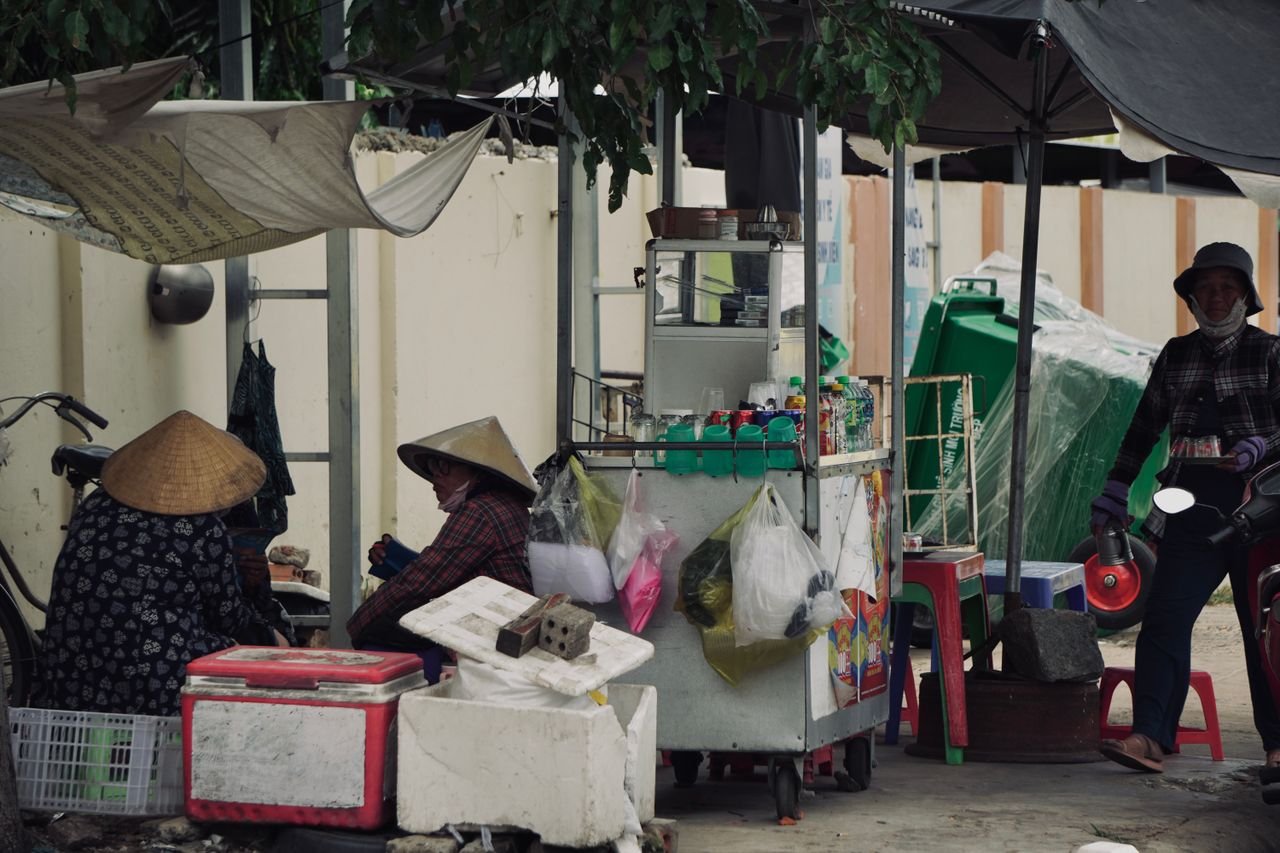 A friendly xin chao opens most market conversations.
Getting Around
| English | Vietnamese | Pronunciation |
|---|---|---|
| Where is…? | …o dau? | uh DOW |
| How much is it? | Bao nhieu tien? | bow nyew tee-EN |
| Left | Trai | CHAI |
| Right | Phai | FYE |
| Straight ahead | Di thang | dee THAHNG |
| Stop here | Dung o day | dung uh DAY |
| Taxi | Taxi | TAK-si |
| Motorbike taxi | Xe om | se UHM |
| Bus station | Ben xe buyt | ben se BWEET |
| Train station | Ga tau | gah TAO |
| Airport | San bay | sahn BAY |
| I want to go to… | Toi muon di… | toy moo-ON dee |
| I don’t understand | Toi khong hieu | toy kohm hee-OH |
| Too expensive | Dat qua | daht KWAH |
| Can you write it down? | Viet ra duoc khong? | vee-ET rah dook KOHM |
Accommodation
| English | Vietnamese | Pronunciation |
|---|---|---|
| Hotel | Khach san | khahk SAHN |
| Guesthouse | Nha nghi | nyah NGEE |
| Do you have a room? | Co phong khong? | koh FOHNG kohm |
| One night | Mot dem | moht DEM |
| How much per night? | Mot dem bao nhieu? | moht dem bow NYEW |
| Air conditioning | Dieu hoa | dyew HOH-ah |
| Wi-Fi password | Mat khau Wi-Fi | maht khao WI-FI |
| Hot water | Nuoc nong | nook NOHNG |
| Check out | Tra phong | chah FOHNG |
| Can I leave my bag? | Toi co the de tui duoc khong? | toy koh teh deh too-ee dook KOHM |
Food and Dining
| English | Vietnamese | Pronunciation |
|---|---|---|
| The menu, please | Xin cho menu | sin cho ME-nu |
| The bill, please | Tinh tien | tin tee-EN |
| Water | Nuoc | nook |
| No ice | Khong da | kohm DAH |
| Delicious | Ngon | NGON |
| Not spicy | Khong cay | kohm KAY |
| I am vegetarian | Toi an chay | toy ahn CHAY |
| No meat | Khong co thit | kohm koh THIT |
| Rice | Com | kuhm |
| Noodles | Bun / Pho | BOON / FUH |
| Beer | Bia | BEE-ah |
| Coffee | Ca phe | kah FEH |
| One more, please | Them mot cai nua | tehm moht kai NOO-ah |
| Cheers! | Mot, hai, ba, yo! | moht, hai, bah, YO |
 Numbers and a few food words go a long way at street stalls.
Numbers
| Number | Vietnamese | Pronunciation |
|---|---|---|
| 1 | Mot | MOHT |
| 2 | Hai | HAI |
| 3 | Ba | BAH |
| 4 | Bon | BOHN |
| 5 | Nam | NAHM |
| 6 | Sau | SOW |
| 7 | Bay | BAY |
| 8 | Tam | TAHM |
| 9 | Chin | CHIN |
| 10 | Muoi | MOO-oy |
| 20 | Hai muoi | hai MOO-oy |
| 100 | Mot tram | moht CHAHM |
| 1,000 | Mot nghin | moht NYIN |
| 1,000,000 | Mot trieu | moht CHYEW |
 Numbers come in handy when bargaining at markets.
Prices in Vietnam are often quoted in thousands of dong - “muoi nghin” (10,000 VND, roughly 40 US cents) comes up constantly at street food stalls. Knowing your numbers dramatically speeds up market negotiations.
Emergency Phrases
| English | Vietnamese | Pronunciation |
|---|---|---|
| Help! | Cuu toi! | KOO-oo toy |
| Fire! | Chay! | CHAY |
| Stop, thief! | An cuop! | ahn KOO-uhp |
| Hospital | Benh vien | ben vee-EN |
| Police | Cong an | kohng AHN |
| I need a doctor | Toi can bac si | toy kahn bahk SEE |
| Call an ambulance | Goi xe cap cuu | goy se kahp KOO-oo |
| I am lost | Toi bi lac | toy bee LAHK |
| I have lost my passport | Toi bi mat ho chieu | toy bee maht hoh CHYEW |
| I am allergic to… | Toi bi di ung… | toy bee dee OOM |
Language Etiquette Tips
Attempt the language. Even a mangled cam on (“thank you”) will earn you goodwill. Vietnamese people find it endearing when foreigners try, and locals will often respond with a big smile or even help correct your pronunciation.
Use written Vietnamese when pronunciation fails. Showing a destination name on your phone - typed in Vietnamese with tone marks - is far more effective than spoken approximations. Google Translate handles Vietnamese well enough for basic communication.
Address people by age, not just “you”. Vietnamese uses different pronouns depending on the relative age of the speakers. For most tourist encounters, using “toi” (I/me) plus pointing or showing your phone sidesteps this completely. If in doubt, use polite formal forms - Xin chao rather than just Chao.
North vs south dialects differ noticeably. The letter “d” is pronounced “z” in the north (Hanoi) and “y” in the south (Ho Chi Minh City). “Gi” sounds like “z” in Hanoi and “y” in HCMC. Neither is more “correct” - they are regional variants. The phrases in this guide use approximate sounds that work in both regions.
Volume is not clarity. Speaking slowly and repeating once is more effective than speaking loudly. If a phrase is not understood, try pointing at the written version or using Google Translate’s camera mode to scan nearby text.
Bargaining language matters. In markets, saying dat qua (“too expensive”) followed by a smile is the standard opening. Negotiating in even basic Vietnamese signals respect and usually results in a better price than negotiating in English.
The biggest pronunciation tip for Vietnam is that tones matter more than consonants. A word spoken with the wrong tone will simply not be understood, no matter how clearly you articulate the letters. When in doubt, point at written Vietnamese on your phone - Vietnamese people read their own language far more easily than they decode foreign pronunciation.
Useful links:
See Also
- Hanoi travel guide - using Vietnamese in the north
- Ho Chi Minh City travel guide - southern dialect differences in HCMC
- Vietnam budget and costs - useful context for bargaining phrases
- Getting around Vietnam - transport vocabulary in practice
Plan Your Trip
Book your flights to Vietnam Get travel insurance Stay connected with an eSIM Rent a car