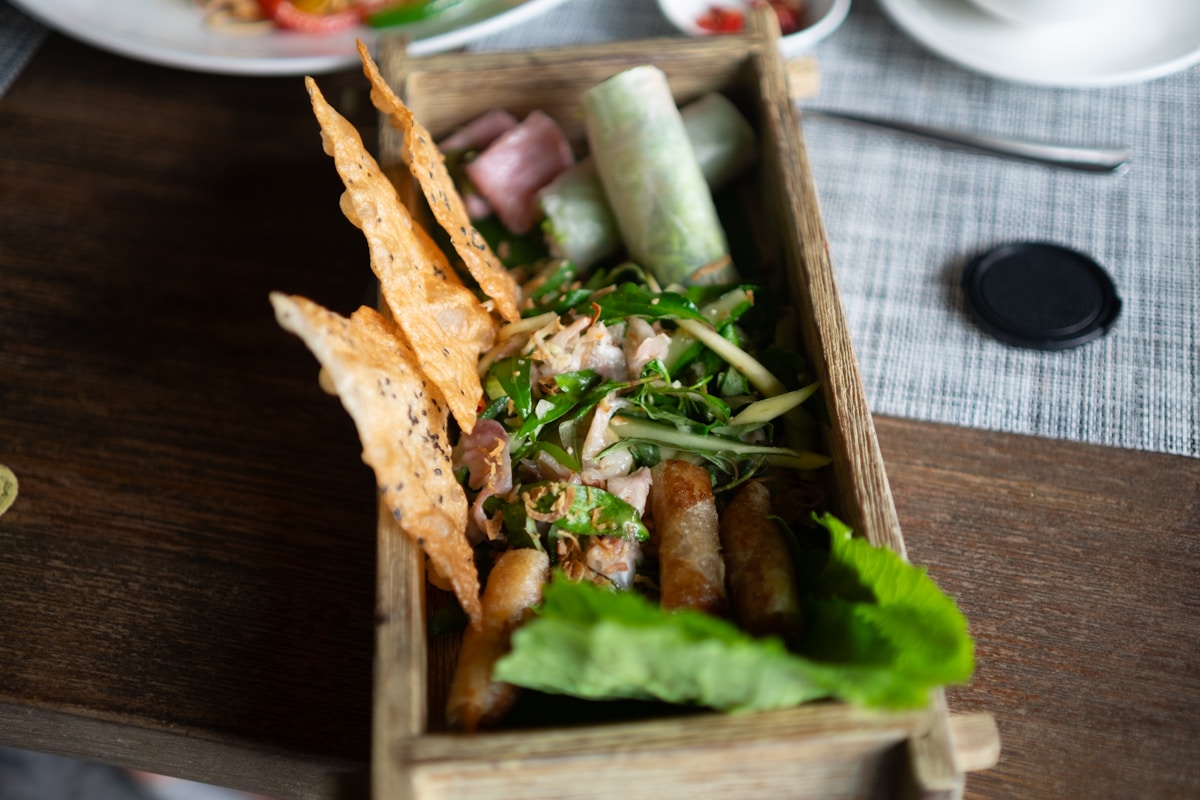
Vietnamese cuisine is one of the world’s great food traditions, and one of its defining characteristics is how dramatically it shifts as you move along the country. The 1,650 km from Hanoi to the Mekong Delta spans three distinct culinary regions: the north cooks with restraint - clear broths, black pepper, minimal sweetness; the Imperial centre goes bold with chilli and lemongrass; the south layers on sweetness and buries every bowl under fresh herbs. Here are the dishes that define each region and matter most to eat on the road.
Pho
The national dish, and the first argument travellers discover about Vietnamese food. A long-simmered beef or chicken bone broth poured over flat rice noodles with thin slices of meat, spring onion, and cilantro - simple at a glance, endlessly debated in practice.
Northern pho (Hanoi): Clear, restrainted broth, wider noodles, no condiment table beyond a little vinegar and chilli. The benchmark shop is Pho Gia Truyen at 49 Bat Dan in the Old Quarter - expect a queue at 7am and a bowl for VND 50,000–65,000 (around $2–2.60 as of 2026). Pho is a morning dish; the best places sell out by 10am.
Southern pho (Ho Chi Minh City): Sweeter broth, thinner noodles, a full condiment spread of bean sprouts, Thai basil, hoisin, and sriracha served alongside. Pho Hoa Pasteur at 260C Pasteur, District 3, is the long-standing Saigon benchmark at VND 75,000–95,000.
Vegetarian-friendly? Pho chay (vegetarian pho) is widely available, particularly in the south. Look for shops that advertise it separately, or ask explicitly - broth is almost always meat-based otherwise.
Banh Mi
A baguette, lightened with rice flour for a crispier shell, stuffed with pate, cold cuts, pickled daikon and carrot, cucumber, coriander, and chilli. French colonialism left Vietnam the baguette; Vietnam made it entirely its own.
Hoi An is the undisputed capital. Banh Mi Phuong (2B Phan Chau Trinh) and Madam Khanh at 115 Tran Cao Van produce exceptional versions for VND 25,000–40,000. In Ho Chi Minh City, Banh Mi Huynh Hoa (26 Le Thi Rieng, District 1) is famous for sheer filling volume at around VND 68,000. In Hanoi, banh mi is slightly less refined but still very good from street carts across the Old Quarter for VND 20,000–35,000.
Vegetarian versions (banh mi chay) with scrambled egg or tofu are easy to find everywhere.
Bun Bo Hue
The central answer to pho - and many diners who try both prefer it. A lemongrass-and-shrimp-paste broth with round rice noodles, sliced beef shank, pork knuckle, and real chilli heat. Where pho is restrained, bun bo Hue is assertive.
Eat it in Hue, where the dish originates - a bowl at market stalls around Dong Ba Market or side-street stalls near the Citadel runs VND 40,000–60,000. It is available across the country but rarely as good elsewhere. Not vegetarian by default - the broth depends on shrimp paste for depth.
Cao Lau
Hoi An’s signature dish and one of the few in Vietnam that cannot be properly replicated elsewhere. Thick, chewy noodles (made traditionally with water from a specific local well) served with char siu-style pork, mustard greens, and crouton-like rice crackers in a small amount of broth. The texture is the point: simultaneously chewy, crispy, and tender in each bite.
Eat it at Hoi An Central Market or from the stalls along Tran Phu Street for VND 30,000–50,000. Any restaurant in the Ancient Town serves it. Pork-based, not vegetarian.
Banh Xeo
A large, crackling turmeric-yellow rice crepe fried in a wok and stuffed with shrimp, pork belly, bean sprouts, and spring onion. The name means “sizzling cake” - you hear it being made before you see it. It is wrapped in rice paper or mustard leaves with herbs, then dipped in a fish sauce and lime dipping broth.
Found across Vietnam but particularly good in Hue (smaller, crispier versions called banh khoai) and in the south, where it is larger and more generously filled. Price ranges from VND 30,000 for a small portion at a street stall to VND 80,000 at a sit-down restaurant. Shrimp and pork versions are standard; vegetarian versions with tofu exist at some market stalls.
Com Tam
Broken rice - the cracked grains rejected from the premium rice trade - grilled over charcoal with a pork chop, shredded pork skin, a fried egg, pickled vegetables, and a sweet fish sauce dressing. Saigon’s default plate and the city’s closest equivalent to a national comfort food.
Every neighbourhood in Ho Chi Minh City has a com tam stall open from early morning. Expect VND 40,000–80,000 depending on the portion size and topping choices. Street-level is often better than restaurant versions. Pork-based; not vegetarian.
Goi Cuon
Fresh spring rolls: rice paper wrapped around rice vermicelli, shrimp, pork slices, lettuce, and mint, served cold with a peanut-hoisin dipping sauce. Light, refreshing, and eaten as a snack or light meal rather than a main dish.
Available everywhere in Vietnam, from beach restaurants to street stalls. Street rolls cost VND 10,000–20,000 each; restaurant versions with larger prawns run VND 30,000–50,000 for two rolls. A genuinely easy vegetarian option exists: goi cuon chay replaces meat and shrimp with tofu and extra vegetables and is common across the country.
Bun Cha
A Hanoi lunch institution and one of the dishes that put northern Vietnamese food on the international map. Grilled pork patties and pork belly served in a sweetened, diluted fish sauce broth alongside a plate of rice vermicelli, fresh herbs, and sliced green papaya. You assemble each bite yourself - a little noodle, a piece of pork, a herb leaf, all dunked into the broth.
Bun Cha Huong Lien at 24 Le Van Huu in Hanoi is the shop the Obama–Bourdain meal made famous, and still worth queuing at for VND 50,000–70,000 a set. Bun cha is a lunchtime-only dish at most places - arrive between 11am and 1pm. Not available in the south in any meaningful form. Not vegetarian.
Banh Cuon
Delicate steamed rice sheets filled with a small amount of minced pork and wood-ear mushroom, served with sliced Vietnamese pork sausage, fried shallots, and a clear dipping sauce. A breakfast dish, lighter than it looks, with a silky texture that requires skill to produce well.
Primarily a northern dish - eaten in Hanoi for VND 30,000–50,000 at morning-only stalls around the Old Quarter. Central and southern versions exist but tend to be thicker and heartier. Vegetarian versions (banh cuon chay) are available at a minority of stalls.
Che
Vietnam’s catch-all category for sweet dessert soups and drinks - shaved ice layered with beans, jellies, lotus seeds, tapioca, coconut milk, and whatever seasonal ingredients the cook prefers. There is no single che; it is a universe of cold sweet bowls served from street carts and dessert shops.
In Hue, che is elevated to near-royal status - the city has dozens of specialist che shops serving multi-layered versions for VND 15,000–30,000. In Ho Chi Minh City, che ba mau (three-colour dessert) with red beans, green jelly, and yellow mung bean is the classic at VND 20,000–40,000. Fully vegetarian and usually vegan.
How to eat well in Vietnam
The rule that holds across all regions: find a shop that cooks one dish, cooks it at volume, and has a full room at meal time. A packed single-dish stall at 7am will beat a quiet ten-page menu every time. Street prices for most dishes sit between VND 30,000 and 80,000 ($1.20–3.20 as of 2026); paying more often buys a dining room rather than better food. Soup dishes are a morning business - arrive before 10am for the best broth. Most stalls that serve breakfast are closed or selling leftovers by midday.
For food tours in Hanoi and Ho Chi Minh City that take the guesswork out of finding the right stalls, see our Vietnam food tours guide. For city-specific breakdowns, see our guides to eating in Hanoi, eating in Ho Chi Minh City, and Vietnamese street food.
Plan Your Trip
Book food tours in Vietnam Get travel insurance Stay connected with a Vietnam eSIM