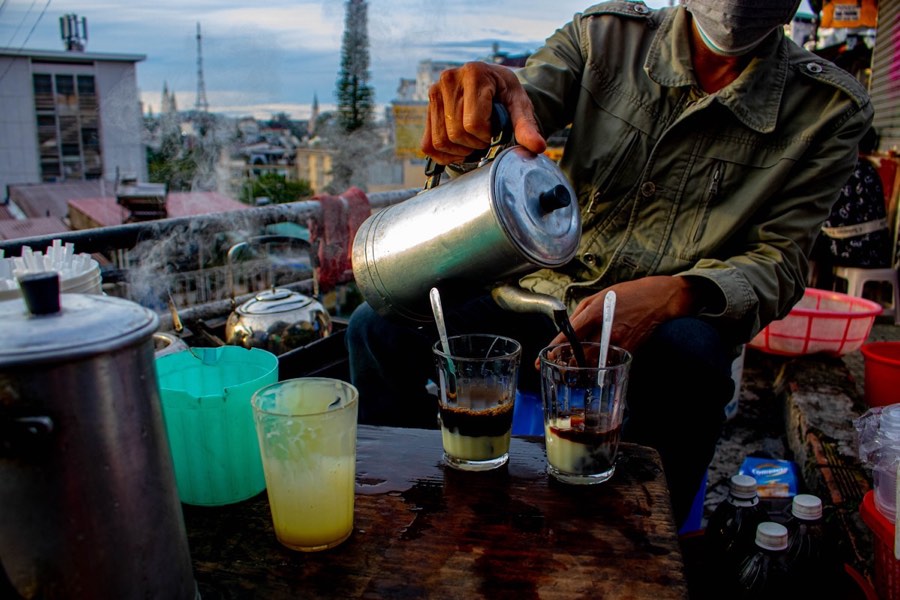
Vietnam is the world’s second-largest coffee producer after Brazil, but its coffee culture bears almost no resemblance to what you find in a Western espresso bar. The country grows primarily robusta beans - darker, more bitter, and higher in caffeine than the arabica that dominates European and American cafes. Vietnamese coffee is almost always brewed through a small metal phin filter that sits on top of the glass, dripping slowly. The result is dense and intense. Condensed milk cuts the bitterness and adds sweetness; ice turns it into ca phe sua da, the drink that defines the country.
Drinking coffee in Vietnam is also a social ritual. Cafes open early - often by 7am - and the pavement stools outside a street coffee shop fill up fast. People sit for an hour, sometimes two, talking, scrolling, watching the street. Coffee costs VND 15,000–35,000 ($0.60–$1.40 as of 2026) at a local shop. Specialty and third-wave cafes charge VND 45,000–120,000 for the same range.
Ca Phe Sua Da - The Classic
Ca phe sua da is iced coffee with condensed milk. The phin filter sits over a glass with a layer of condensed milk at the bottom. The coffee drips through slowly - taking 5–10 minutes - producing a strong concentrate. You stir it into the condensed milk, pour it over ice, and drink. The combination is sweet, bitter, and intensely caffeinated.
The drink is available everywhere in Vietnam: at street stalls, in restaurants as a standard menu item, and at dedicated ca phe shops. Price ranges from VND 15,000 at a basic pavement stall to VND 55,000 at a tourist-facing cafe. The cheap version is not inferior - the difference is mostly in setting.
Ca phe den (black coffee, no milk) is the unsweetened version, served hot or over ice. If you don’t want the sweetness of condensed milk, specify “ca phe den da” (iced black coffee).
Egg Coffee (Ca Phe Trung) - Hanoi’s Invention
Egg coffee was invented in Hanoi in the 1940s when fresh milk was scarce. Nguyen Giang, a bartender at the Sofitel Metropole, substituted whipped egg yolk for milk, creating a topping that is somewhere between a zabaione and a warm sabayon - sweet, rich, and foamy - poured over a shot of strong Vietnamese coffee. The drink became a Hanoi institution and has since spread (in lesser versions) across Vietnam and into specialty coffee shops globally.
The authentic version is served warm, in a small ceramic cup sitting in a bowl of hot water to maintain temperature. The egg yolk cream is whipped with condensed milk and a small amount of sugar; in some versions, a small amount of cheese or butter is added. You drink it by sipping through the foam or stirring it in.
Ca Phe Chon - Weasel Coffee
Weasel coffee (ca phe chon) is Vietnamese civet coffee. Asian palm civets eat ripe coffee cherries, digest them - enzymes in their digestive tract alter the bean’s protein structure - and the beans are collected, cleaned, and roasted. The process is supposed to produce a less bitter, smoother cup. Vietnam and Indonesia both produce versions of this coffee; the Vietnamese variety is primarily from the Central Highlands.
Authentic, ethically produced weasel coffee - where civets forage freely rather than being caged - is rare and commands a high price: VND 250,000–600,000 ($10–$24 as of 2026) per cup at reputable sellers. Most “weasel coffee” sold cheaply in tourist areas is either artificially processed (applying enzymes to replicate the effect) or mislabelled entirely.
If you want to try it: Trung Nguyen Legend Cafe has branches in both Hanoi and Ho Chi Minh City and sells verified varieties, including weasel coffee by the cup. Expect to pay in the VND 150,000–300,000 range.
Ethical note: Caged civet coffee farming is a welfare concern. Seek out establishments that can demonstrate their civet coffee comes from free-range animals. The majority of tourist-market weasel coffee comes from caged farms.
Third-Wave Coffee in Vietnam
Alongside the traditional phin-filter culture, a serious third-wave coffee scene has developed in Hanoi, Ho Chi Minh City, and Da Lat (Vietnam’s highland coffee-growing region). These cafes use arabica and specialty robusta beans from the Central Highlands, brew on V60 or Chemex, and take filter ratios seriously.
Da Lat is worth noting specifically: it sits at 1,500m in the Central Highlands and has a cool, misty climate that supports arabica production not viable elsewhere in Vietnam. Several farms around Da Lat offer tastings and farm visits. See our Da Lat guide for more.
Useful links:
Where to Drink: Cafe Picks by City
Vietnam’s cafe scene varies sharply by city — Hanoi favours tradition and egg coffee, Ho Chi Minh City mixes old pavement culture with slick third-wave bars, and Da Lat has a farm-to-cup identity no other city can match. Below are verified picks in each of the five best cafe cities.
Hanoi
Cafe Giang — 39 Nguyen Huu Huan, Old Quarter. The original egg coffee shop, open since 1946 when founder Nguyen Van Giang first whipped egg yolk with condensed milk as a milk substitute. The space is tiny: a narrow staircase leads to a low-ceilinged room packed with small tables. Order ca phe trung (egg coffee) — it arrives warm in a ceramic cup nested in a bowl of hot water. Price: VND 30,000–55,000 as of 2026. Best visited: 8–10am before tour groups arrive, or after 4pm when the street quiets slightly.
Ca Phe Nhan — 31 Hang Hanh, Hoan Kiem. A Hanoi institution that has been serving phin-drip coffee since the 1980s. No fancy fitout — wooden stools, a pavement counter, and a proprietor who still runs the same filter she has for decades. Coffee is strong, dark, and genuinely cheap: VND 15,000–25,000. Best visited: early morning (6:30–9am) when locals stop in on the way to work. The atmosphere at 7am is hard to replicate anywhere else in the city.
The Note Coffee — 64 Luong Van Can, Old Quarter. Every surface is covered in sticky notes left by previous visitors. The coffee itself — ca phe sua da, smoothies, and a handful of specialty options — is competent rather than exceptional, but the atmosphere is worth it. VND 40,000–70,000. Best visited: late afternoon when the light through the upper-floor windows is good. Avoid peak midday when it fills with tour groups.
Ho Chi Minh City
The Workshop Coffee — 27 Ngo Duc Ke, District 1. Ho Chi Minh City’s clearest example of third-wave Vietnamese coffee done well. The space is a converted warehouse; the menu covers pour-overs, V60, cold brew, and traditional phin — all using single-origin beans from the Central Highlands. Prices sit at VND 65,000–120,000 as of 2026. Best visited: weekday mornings (8–11am) when it functions as a serious work cafe; weekends attract more foot traffic and noise.
Cộng Cà Phê — multiple District 1 and District 3 branches. Communist-era aesthetic — olive green walls, propaganda posters, vintage military gear — has made Cong a photogenic chain that somehow manages to also make excellent drinks. The coconut coffee (ca phe cot dua) is the standout: cold brew poured over condensed milk and coconut cream, VND 55,000–75,000. Best time: afternoons for the coconut coffee; mornings if you want a quieter seat.
Trung Nguyen Legend Cafe — 587 Nguyen Kiem, Phu Nhuan District. The flagship experience cafe from Vietnam’s largest coffee brand. Offers a full tasting menu of Vietnamese coffee varieties including weasel coffee (ca phe chon), high-grown arabica, and blended robusta, served with ceremony. Weasel coffee by the cup: VND 150,000–300,000; standard ca phe sua da VND 45,000–65,000. Best visited as a dedicated coffee experience rather than a quick stop — the tasting menu takes 45–60 minutes.
Hoi An
Hoi An Roastery — 135 Tran Phu, Ancient Town. One of the few cafes in Hoi An that sources and roasts its own beans from the Central Highlands. Pour-overs, AeroPress, and traditional phin available; staff can explain the difference. VND 55,000–95,000. The narrow shophouse has a rooftop terrace — sit up there in the early morning before Ancient Town fills with day-trippers. Best time: 7–9am.
The Cargo Club — 107–109 Nguyen Thai Hoc, Ancient Town. Best known as a restaurant, but the ground-floor cafe section makes solid Vietnamese coffee and proper espresso-based drinks. Useful if you want to combine coffee with a pastry or light breakfast. VND 50,000–85,000. The riverside terrace has one of the best views in Hoi An; arrive before 10am for a guaranteed seat.
Morning Glory Coffee (associated with the restaurant group of the same name) — Thi Sach Street, near the market. Traditional phin coffee at pavement prices alongside a market-facing counter. Ca phe sua da for VND 20,000–35,000. Not a destination cafe, but an honest local experience in the middle of Hoi An’s produce market. Best time: 6:30–9am when the market is at full activity.
Da Lat
Café Tung — 6 Khu Hoa Binh (Peace Square). Da Lat’s oldest surviving cafe, open since 1952. The decor has not changed noticeably in decades: dark wood panelling, low lighting, old photographs, and a classical music soundtrack that ranges from Beethoven to Chopin. The coffee is traditional phin robusta — strong, served with condensed milk. VND 25,000–45,000. Artists, students, and older Da Lat locals are the regulars. Best time: early afternoon (1–4pm) when the square outside slows down after lunch.
V+ Coffee — 3B Nguyen Si Sach. Da Lat-focused specialty cafe that sources highland arabica directly from farms in the surrounding hills. Single-origin pour-overs sit alongside traditional phin; the menu notes elevation and processing method for each lot. VND 55,000–95,000. Da Lat’s climate — cool and often misty — means this is a good place for a long sit with a V60 and a book. Best time: mornings or late afternoon when the fog rolls in.
The Married Bean — 3/3 Duong Ngo Quyen, near Xuan Huong Lake. Small, well-designed cafe with a menu covering specialty single-origins and traditional Vietnamese preparations side by side. The lakeside neighbourhood is quieter than the central market area. VND 45,000–85,000. Best time: late morning (9–11:30am) before the lunchtime crowds reach this part of town.
Hue
Hue is the home of ca phe muoi — salt coffee — a drink invented here in 2010 before spreading across Vietnam. The preparation layers salted cream over condensed milk and strong Vietnamese coffee; the result is bitter, sweet, and faintly savoury in a way that works far better than the name suggests. Alongside salt coffee, the city has a quieter, more contemplative cafe culture than Hanoi or HCMC: garden houses, riverside terraces, and traditional teahouses dominate over the slick specialty bars.
Ca Phe Muoi — 142 Dang Thai Than, Thuan Hoa. The original salt coffee shop, opened in 2010 by the pair who created ca phe muoi before it became a city-wide institution. The cafe is small and unpretentious — the focus is entirely on the drink. Price: VND 25,000–40,000 as of 2026. Best visited: morning (7–10am) when the coffee is freshest and the queue is shortest. Every other salt coffee in Hue traces back here.
Root Coffee Roastery — 43 Ngo Quyen, Vinh Ninh. One of Hue’s few specialty cafes roasting its own beans on-site. The menu covers traditional Vietnamese preparations alongside Western espresso drinks; coconut coffee and egg coffee are the standout options alongside the standard ca phe sua da. Air-conditioned interior upstairs, balcony seating above. VND 40,000–85,000 as of 2026. Open 6am–10:30pm daily. Best time: early morning when the roasting smells come through, or afternoon for the balcony.
Vy Da Xua — 131 Nguyen Sinh Cung, Vy Da Ward. A traditional garden-house cafe sitting on the banks of the Perfume River, designed in the style of an old Hue timber house with bonsai trees, stone water features, and an enclosed garden courtyard. Coffee is traditional phin; the setting is the main draw. VND 35,000–70,000 as of 2026. Open 7am–10pm daily. Best time: late afternoon (4–6pm) when the riverside light softens and the garden cools.
Coffee Etiquette and Practical Notes
Don’t rush the phin. The filter takes 5–10 minutes to drip through; this is not a failing of the cafe but the nature of the brewing method. Vietnamese coffee culture is not about speed.
Condensed milk is default. If you order ca phe without specifying, condensed milk will often arrive automatically. Ask for “ca phe den” (black) or “ca phe sua” (with milk) to be specific.
Opening hours: Street stalls open from 6–7am and often close by early afternoon. Specialty cafes typically open 8am–10pm.
Tipping: Not customary at street coffee shops. At sit-down specialty cafes, rounding up the bill or leaving VND 10,000–20,000 is appreciated but not expected.