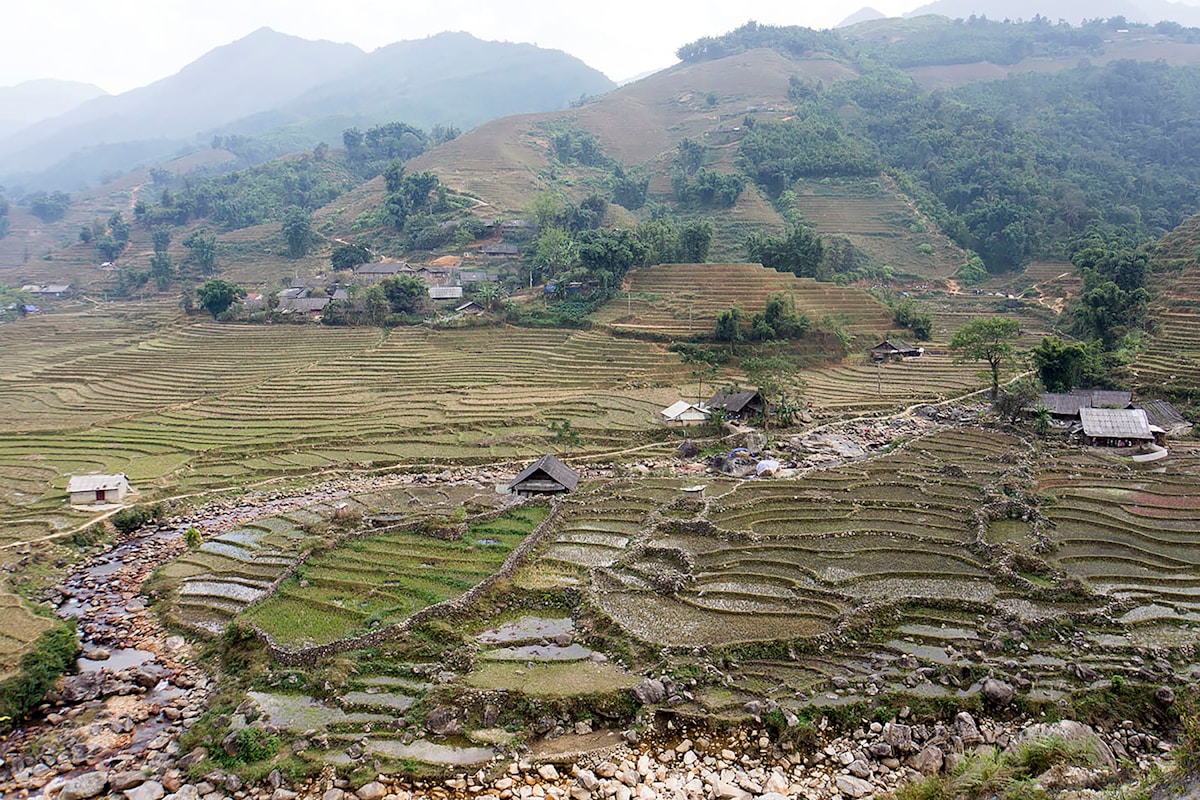
Sapa’s trekking industry is large and well-developed. The range of routes spans from 30-minute village walks to 2-day Fansipan summit climbs. Here is an honest assessment of the main options, with actual difficulty ratings, costs as of 2026, and advice on what the experience really looks like.
Cat Cat Village (easy, 1–2 hours)
The closest trek to Sapa town. A mostly downhill 3km walk into a Black Hmong village in the Cat Cat valley, with a small waterfall and terraced paddies. The path is paved in most sections and the gradient is gradual. Entry fee approximately ₫70,000 ($2.80).
The honest note: Cat Cat is the most commercialised village in the Sapa area. The path is lined with stalls, and women in traditional dress will approach you to buy embroidery and silver jewellery. This is their livelihood and the interaction is not unpleasant - just expect it. The scenery is worth the visit regardless of the tourism overlay.
Who it’s for: Families with children, anyone with limited mobility, those wanting a brief introduction to the landscape before committing to a full-day trek.
Y Linh Ho to Lao Chai and Ta Van (moderate, half-day to full day)
The most popular proper trek from Sapa. The route descends into the Muong Hoa Valley, passing through rice terraces before arriving at a Black Hmong village (Lao Chai) and a Giay village (Ta Van). Starting via Y Linh Ho adds a quieter approach through a less-visited valley section.
Distance: 12–18km depending on extension. Difficulty: Moderate - some steep sections on valley sides, clay paths that become slippery in rain. Duration: 4–6 hours.
Guide: A local guide is recommended. Not because the route is technically difficult but because a guide provides genuine context about Hmong and Giay communities. Female Hmong guides are the standard for this route and can facilitate conversations with villagers that wouldn’t otherwise happen. Day rate approximately ₫300,000–600,000 ($12–24).
Extension: The route can be pushed further to Ta Giang Phinh or Ban Ho for a full day. These extensions have noticeably fewer tourist groups than the Lao Chai section.
Ta Phin Village Homestay Trek (moderate, full day or overnight)
Ta Phin is a Red Dao village 12km northeast of Sapa town, set in a valley surrounded by terraced fields. The route passes through Black Hmong settlements before arriving at Ta Phin, where the Red Dao are known for their distinctive embroidered clothing and herbal bathing traditions.
Distance: 10–14km one way. Difficulty: Moderate - some sustained climbs but on clearer paths than the Muong Hoa Valley routes. Duration: 4–5 hours one way, 1–2 days with homestay.
Homestay: Several families in Ta Phin take overnight guests. Expect basic wooden guesthouses with shared facilities, home-cooked meals, and the chance to observe daily village life. Overnight homestay with dinner and breakfast costs approximately ₫200,000–350,000 ($8–14) per person. Arrange through your Sapa guesthouse or a local operator.
Honest note: Ta Phin is less visited than the Muong Hoa Valley circuit, which is its main draw. The village itself is also more economically active - herbal bath businesses and craft stalls are prominent. Go for the landscape and the slower pace, not for an untouched village experience.
Fansipan Summit (strenuous, 2 days)
Fansipan at 3,143m is the highest peak in mainland Southeast Asia. The traditional 2-day trek starts from Tram Ton Pass (1,900m), 15km from Sapa. A registered guide is required under Hoang Lien National Park regulations.
Day 1: Tram Ton Pass to camp at approximately 2,800m. Around 5–6 hours of steady climbing through forest, with altitude gain increasing throughout. Day 2: Camp to summit and descent. The final push to the summit takes 2–3 hours; descent to the pass takes 4–5 hours.
Difficulty: Strenuous. The trail involves rocky scrambles above the treeline and can be treacherous in wet conditions. Fit hikers who train regularly will find it demanding but achievable. Distance: Approximately 19km return.
Cost: Guided 2-day treks with a licensed guide, meals, and mountain hut accommodation cost approximately ₫1,500,000–2,500,000 ($60–100) per person as of 2026. Smaller groups typically pay more per person. National park entry fees are included.
Cable car alternative: Vinpearl operates a cable car from the valley to near the summit. Journey time is 15 minutes and it operates year-round. The cable car costs approximately ₫750,000 ($30) for a return ticket. This is a completely different experience from trekking - legitimately worth it for those unable to trek but not a trekking substitute.
Top Sapa Treks at a Glance
Here’s a quick comparison of top-rated Sapa treks available on GetYourGuide:
| Trek | Duration | Price (from) | Group Size | Route |
|---|---|---|---|---|
| Lao Chai & Ta Van Village Trek | Full day | from $25/person | Small group | Muong Hoa Valley, Hmong village, Giay village, lunch |
| Sapa & Fansipan Cable Car Day | Full day | from $35/person | Group | Fansipan cable car, summit visit, Cat Cat village |
| 2-Day Highland Trek with Homestay | 2 days | from $70/person | Small group | Ta Phin village, Red Dao homestay, highland food |
| Bac Ha Sunday Market Day Trip | 8–9 hrs | from $30/person | Group | Flower Hmong market, Bac Ha old town, local transport |
| Cat Cat & Y Linh Ho Half-Day | 4–5 hrs | from $18/person | Small group | Cat Cat village waterfall, valley descent, guide |
Browse all Sapa trekking tours → GetYourGuide
Named Trekking Operators in Sapa
Sapa Sisters - locally run agency employing female Hmong and Dao guides who grew up in the villages on the routes. Day treks from approximately ₫500,000–900,000 ($20–36) per person depending on route and group size. Well-regarded for guide quality and for channelling money directly to guide families. Book via sapasisters.com. You can also browse Sapa trekking tours on GetYourGuide for curated guided trek packages from Hanoi.
Topas Travel - Scandinavian-owned operator running the Topas Ecolodge near Thanh Phu, 18km from Sapa. Multi-day treks with lodge accommodation cost from approximately $150–250 USD per person per night, all-inclusive. Higher end of the market but with a stronger environmental record than most. Topasadventure.com.
Backstreet Academy - network connecting travellers with local experts including Sapa area guides. Day experiences start from approximately ₫400,000 ($16). Best for shorter, culturally-focused experiences rather than multi-day treks. Backstreetacademy.com.
Local guesthouses on Fansipan Street - most guesthouses in Sapa organise trekking directly through staff contacts with local guides. Standard day rate ₫300,000–600,000 ($12–24). Quality varies; ask to meet the specific guide before booking.
Prices listed are approximate as of 2026 and subject to seasonal variation.
Best Season to Trek in Sapa
September to November is the best season. The monsoon ends in August and the rice terraces are in full harvest - golden terraced hillsides, clear skies, and dry trails. This is peak photography season for a reason.
March to May is the second-best window. New rice has been planted, the paddies are a vivid green, and temperatures in Sapa town (around 15–20°C) are comfortable for walking. Crowds are lighter than July–August.
July–August (peak Vietnamese holiday season) is the busiest period. Trails are busiest, accommodation prices are highest, and afternoon thunderstorms make some routes slippery. The terraces are deep green and impressive, but expect trail traffic on the Lao Chai route.
December–February brings cold fog to Sapa. Temperatures can drop below 5°C and the mountain is frequently socked in cloud. The landscape is atmospheric but views from Fansipan are often non-existent. Snow occasionally dusts the higher slopes.
What to Pack
Footwear: Trail shoes or light hiking boots with grip. Sandals and flat-soled shoes are inadequate for the valley descents, especially in wet conditions. The clay paths in the Muong Hoa Valley become extremely slippery after rain - good grip is the most important single item.
Clothing: Layers. Sapa town can be cool even in summer, and the temperature drops sharply above 2,000m. Bring a waterproof shell. A lightweight fleece is useful even in April–May.
Other essentials: 2 litres water minimum for a day trek, snacks, small first aid kit, sun protection (UV is strong at altitude even on overcast days), trekking poles for the descent sections, and a portable battery for your phone.
For homestay treks: Small gifts for homestay families (fruit, basic medicines, school supplies for children) are appreciated but not expected. A headtorch is essential - village electricity is often unreliable after dark.
Rice Terrace Photography Tips
The Muong Hoa Valley terraces are among the most photographed landscapes in Southeast Asia. A few things that make a practical difference:
Timing: Early morning (before 8am) and late afternoon (after 4pm) give the best light on the terraced hillsides. Midday light is harsh and flattens the texture of the terraces. If you want mist in the valley, early morning in October–November often delivers it.
Position: The terraces look best from elevation looking down across multiple levels. Descents into the valley (such as the first section of the Lao Chai route) offer natural elevated viewing points. Don’t stop at the first viewpoint you see from the Sapa town road - the views improve as you descend.
Seasons in the terrace: Vivid green (May–June, new planting), lush green (July–August, growing season), golden (September–October, harvest). All are visually striking; choose based on the colour palette you’re after.
The villages: Ask your guide before photographing people in villages. Many guides will facilitate introductions that make portrait photography natural rather than intrusive.
Altitude and Fitness Considerations
Sapa town sits at approximately 1,500m. Most visitors from low-altitude destinations feel some mild breathlessness on the steeper ascents but altitude sickness is uncommon at these elevations.
For the Fansipan trek, the altitude gain from Tram Ton Pass to the summit is around 1,200m in a single day. Spend at least one night in Sapa town before attempting Fansipan - this gives your body a day to begin adjusting to 1,500m before the harder climb. If you have a history of altitude sensitivity or cardiovascular conditions, consult a doctor before booking.
For the day treks (Cat Cat, Lao Chai–Ta Van), a reasonable base level of fitness is sufficient - these routes are walkable by most people in average health, just at a slow pace with rest stops.
Book a Sapa Trekking Tour
Here’s how the main trekking options compare:
| Tour | Duration | Price (from) | Group Size | Highlights |
|---|---|---|---|---|
| Sapa 1-Day Trek — Lao Chai, Ta Van and Giang Ta Chai | Full day | from $30/person | Small group | Black Hmong guide, Muong Hoa Valley, river crossing, 14km loop |
| Sapa 2-Day Trek with Hmong Family Homestay | 2 days | from $110/person | Small group | Remote villages, overnight homestay, traditional dinner, morning farmwork |
| Fansipan Trek — 2-Day Summit Attempt (No Cable Car) | 2 days | from $150/person | Up to 6 | Camp below summit, 3,143m climb, porter support, experienced guide |
| Sapa Village Trek + Cooking Class Combo | Full day | from $45/person | Small group | Morning trek to Black Hmong village, afternoon hands-on cooking session |
| Sapa 3-Day Remote Village Trek — No Tourist Trail | 3 days | from $175/person | Up to 5 | Off-the-map routes, two village homestays, rice wine evenings, silence |
Browse all Sapa trekking tours → GetYourGuide
More in Sapa
- Best Hostels in Sapa 2026: Budget Stays in the Northwest Highlands
- Best Hotels in Sapa 2026: Mountain Lodges and Boutique Stays
- Best Restaurants in Sapa 2026: Local Food and Highland Specialties
- Day Trips from Sapa 2026: Bac Ha Market, Can Cau and Y Ty
- Hill Tribe Villages Near Sapa 2026: Hmong, Dao and Tay Communities
- Sapa Rice Terraces 2026: When to Visit and Where to See Them
- Things to Do in Sapa 2026: Treks, Villages and Fansipan
- Best Hotels in Sapa 2026: Town Hotels vs Valley Homestays