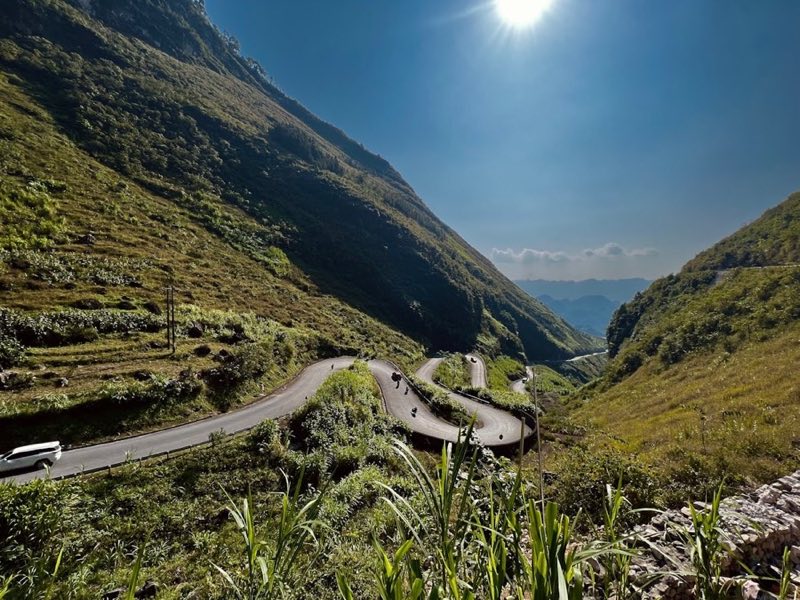
The Ha Giang Loop is one of Southeast Asia’s most dramatic motorbike routes - four days of switchbacks, cliff-edge passes, and ethnic minority villages in Vietnam’s far north. Most travellers face the same decision before they leave: hire an Easy Rider guide, or rent a bike and go solo. This page explains both options, the route variations, operator prices in 2026, and everything you need to know about the permit before you leave Ha Giang city.
Top Tours at a Glance
| Tour | Duration | Price (from) | Group Size | Highlights |
|---|---|---|---|---|
| Ha Giang Loop 3-Day Easy Rider Package | 3 days | from $159/person | Max 9 | Hanoi sleeper bus, private Easy Rider guide, homestays, Ma Pi Leng Pass |
| Ha Giang Loop 4-Day with Easy Rider (from Hanoi) | 4 days | from $220/person | Max 8 | Quan Ba Heaven Gate, Dong Van Geopark, Lung Cu flagpole option, most meals |
| Ha Giang Loop 2-Day Motorbike Tour | 2 days | from $119/person | Small group | Compact loop, Lung Cu Flag Tower, ethnic minority villages |
| 1-Day Ha Giang Mini Loop (Easy Rider) | 8 hrs | from $55/person | Private | Quan Ba Heaven Gate, Yen Minh pass, ideal if time-limited |
| Ha Giang 3-Day Small Group Private Room | 3 days | from $175/person | Max 6 | Private accommodation, vetted guides, Meo Vac market |
Browse all Ha Giang Loop tours → GetYourGuide
Easy Rider Guide vs Self-Drive
Easy Rider guides are experienced local drivers who take you as a pillion passenger on their motorbike. You ride behind them, they navigate, and they act as interpreter in villages where no one speaks English. The name comes from central Vietnam’s original Easy Rider culture in Dalat - Ha Giang has developed its own version over the past decade.
The case for a guide is strong:
- The roads include blind corners, unpaved sections, and steep descents that punish riders without mountain experience
- Mechanical breakdowns happen; your guide handles them
- Ethnic minority villages (Hmong, Lo Lo, Nung, Tay) are the highlight of the loop, and genuine conversation requires a local who speaks the language
- You’re free to look at the scenery rather than the road
Self-drive makes sense if you have significant off-road or mountain riding experience. The main challenge isn’t the distance (roughly 350 km for the classic loop) - it’s the road surface on the remote northern sections, which can be unpaved or badly potholed. A semi-automatic Honda Win 110 or a manual Minsk is the standard rental in Ha Giang city, available for approximately 150,000–250,000 VND per day (around $6–10 USD as of 2026). Most rental shops will ask for your passport as a deposit.
Route Options
Classic Ha Giang Loop (3–4 days)
The standard loop covers approximately 350 km and takes three to four full riding days. The typical circuit from Ha Giang city:
Day 1 → Dong Van (~120 km): Climb to Quan Ba Heaven Gate for the Twin Mountains viewpoint, continue to Yen Minh, and push on to Dong Van through the Dong Van Karst Plateau Geopark - a UNESCO Global Geopark with some of the most ancient exposed rock formations in Asia.
Day 2 → Meo Vac via Ma Pi Leng Pass: The morning ride from Dong Van to Meo Vac crosses Ma Pi Leng, the loop’s signature pass. The road clings to a cliff face above the Nho Que River gorge - roughly 200 metres of void between you and the turquoise water below. The name translates roughly as “nose of a horse,” and it’s an accurate description of the angle. Stop at the viewpoint on the pass before descending into Meo Vac for the night.
Day 3 → Du Gia via Tham Ma Slope: Du Gia sits in a valley on the loop’s eastern leg. The road out of Meo Vac climbs Tham Ma, a long slope with tight hairpin switchbacks and views back over the high plateau. Du Gia itself is quieter than Dong Van - a riverside village with homestays run by Tay families.
Day 4 → Ha Giang city: The return leg is flatter and faster. Most guides stop at rice terrace viewpoints above Ha Giang city before the loop closes.
Northern Extension: Lung Cu and the Chinese Border (add 1–2 days)
Many guides now include a northern loop via Lung Cu, where Vietnam’s northernmost flagpole sits on a hilltop a few kilometres from the Chinese border. The detour adds one or two days to the trip but is worth it for the landscape around Lung Cu village and the Lo Lo Chai ethnic village at the flagpole base. You’ll need to specify this extension when booking, as not all operators include it by default.
Permit Requirements
A permit is required for foreign visitors to the Ha Giang border zone. The process is straightforward but non-negotiable:
- Apply at the Ha Giang Immigration Office (Phòng Xuất Nhập Cảnh), located a short walk from the main bridge in Ha Giang city
- Cost: approximately 20,000 VND ($1 USD) per person as of 2026 - effectively free
- Processing time: same day in most cases, sometimes within the hour
- You will need your passport and a clear photocopy
- The permit covers travel in the restricted border zone and is checked at police checkpoints on the route
Your guide or hostel will typically walk you through this on arrival evening. Do not leave for the loop without it - checkpoints are real and the fine for foreigners without permits is a significant inconvenience.
Operators and Prices (2026)
Easy Rider Guide Hire
Hiring a dedicated guide means they drive you on their motorbike. Prices are per person, per day, and vary by operator and whether accommodation is included.
Ha Giang Loop Easy Riders - one of the most established operations in town, operating since the loop became popular around 2016. Guides are vetted for experience on the northern roads. Rates: approximately 900,000–1,200,000 VND per day ($35–50 USD), or from around 3,500,000 VND ($140 USD) for a four-day loop including guide, fuel, and basic homestay accommodation. Premium guides with strong English from approximately 4,500,000 VND ($180 USD) for four days.
Vietnam Loop Riders - focuses on smaller groups (max four riders per tour). Rates: from approximately 4,000,000 VND ($160 USD) per person for a three-day classic loop, homestays included. Northern extension to Lung Cu: add approximately 700,000 VND ($28 USD) per person.
Local hostel-arranged guides - most hostels in Ha Giang city (notably Hmong Sisters Hostel and the well-reviewed backpacker guesthouses on Tran Hung Dao street) can arrange Easy Rider guides directly. Rates are competitive: approximately 800,000–1,000,000 VND per day ($32–40 USD). Vet your guide with a conversation the night before - language ability and road familiarity vary.
Group Tour Packages
If you want to share costs, a pre-organised group tour (typically 4–8 people on a mix of guides and self-drivers in convoy) runs approximately 2,500,000–3,500,000 VND ($100–140 USD) per person for three days, including guides, accommodation, and most meals.
GYG-Listed Full Packages ($250–400 per person, as of 2026)
Operators listed on GetYourGuide typically bundle the full Ha Giang Loop experience - Hanoi pickup, overnight bus transfer, 3–4 days on the loop with a private Easy Rider guide, homestay accommodation, most meals, and return transport to Hanoi. These all-inclusive packages run approximately $250–400 per person (as of 2026), depending on group size and whether you add the Lung Cu northern extension. The premium end ($350–400) generally includes stronger English-speaking guides and small-group sizes of two to four people.
This higher price point reflects the logistics of getting you from Hanoi and back, not just the loop itself. If you’re already in Ha Giang city, arranging directly with a local operator is consistently cheaper. If you’re time-limited and want a seamless booking from Hanoi, GYG packages are worth the premium.
Search GetYourGuide for Ha Giang Loop tours with verified departure dates - particularly useful if you’re arriving from Hanoi and want everything pre-arranged before you reach Ha Giang city.
Difficulty Levels
| Level | Route | Who it suits |
|---|---|---|
| Easy | Classic loop as pillion with Easy Rider guide | First-time visitors, non-riders |
| Moderate | Self-drive classic loop, paved roads | Experienced road riders |
| Hard | Northern extension, some unpaved sections | Mountain biking or off-road experience |
| Expert | Full northern loop in wet season | Only attempt if you’ve ridden technical mountain roads before |
The loop is not physically demanding as a passenger - the challenge is mental resilience on exposed cliff roads. If heights bother you seriously, the Ma Pi Leng section requires some composure.
What’s Included with a Guided Tour
A full-service Easy Rider package typically covers:
- Guide + motorbike (you ride pillion)
- Fuel for the entire loop
- Basic homestay accommodation (mattress on floor or simple bed, communal bathroom)
- Breakfast at each homestay
- One or two lunches en route at local restaurants
- Entrance fees to the Dong Van Geopark viewpoints
- Police checkpoint navigation (your guide handles the paperwork)
Not included unless stated: evening meals beyond the homestay breakfast, any alcohol, tips for homestay hosts (customary - approximately 20,000–50,000 VND per night), entry to specific cultural sites, and travel insurance.
Best Season
October to April is the reliable window. The plateau is dry, road surfaces are at their best, and the sky gives the views their full depth. October is particularly good - the rice terraces in the valleys below Du Gia are still golden.
May to September: Rain season. Roads in the northern section become muddy and some unpaved sections are genuinely risky after heavy rain. The views are often obscured by low cloud. Experienced riders do the loop year-round, but the risk calculus changes.
Buckwheat flower season (October–November): The Dong Van plateau turns pink with buckwheat blossoms - the most photographed version of the loop. Book guides weeks in advance if your dates land here.
Practical Notes
- The loop starts and ends in Ha Giang city, which is about 5–6 hours by bus from Hanoi (or 4.5 hours by sleeper bus). Several operators offer combined Hanoi transfers
- Riding helmet quality varies; bring your own if you’re particular about safety standards
- Mobile signal is good on the main route but drops in valley sections - download offline maps before leaving
- Homestay infrastructure is basic but improving; charge all devices every night
- Temperatures at altitude drop sharply after dark even in summer - bring a layer regardless of when you travel
Plan Your Visit
- Ha Giang travel guide - overview of the city, getting there, and what else to do
- Ha Giang Loop route planning - detailed route breakdown with distances and waypoints
- Motorbike rental in Ha Giang - if you plan to self-drive
- Best Hotels in Ha Giang - hostel and guesthouse options before and after the loop
- Best time to visit Vietnam - how the loop fits into a broader Vietnam trip
- Ha Giang tours and guided motorbike trips - browse Easy Rider guides and loop packages via GetYourGuide