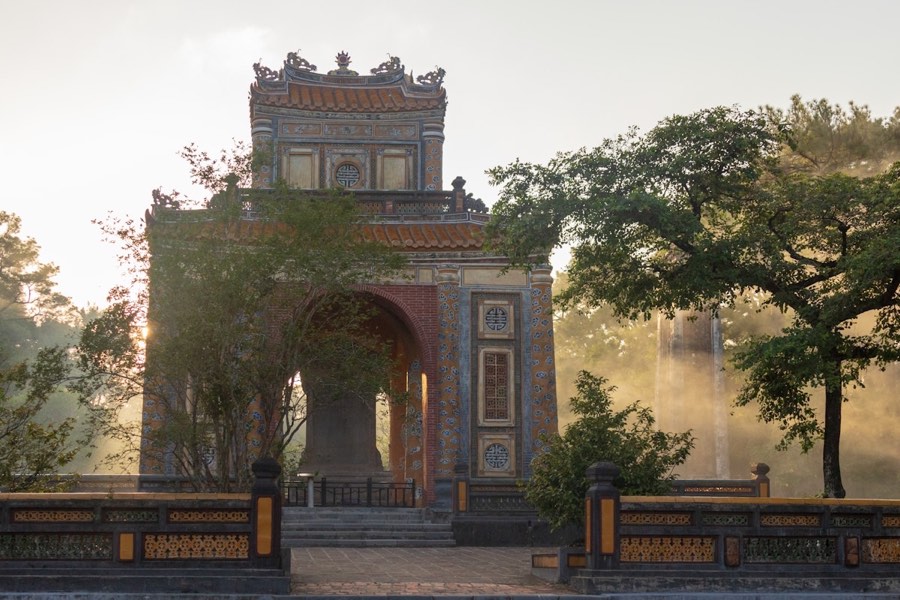
Seven Nguyen emperors built elaborate tomb complexes in the hills south of Hue along the Perfume River. Each is architecturally distinct - the emperors commissioned designs reflecting their individual tastes and beliefs. Three tombs receive most visitors.
Khai Dinh Tomb
Built 1920–1931 by Emperor Khai Dinh. The most visually unusual of the tombs - it fuses Vietnamese imperial form with French Baroque influence, resulting in something unlike anything else in Vietnam.
The approach is a broad staircase flanked by stone elephant and warrior honour guard statues. The main structure sits on a hillside and is covered inside with an extraordinary mosaic - every centimetre of wall, ceiling, and floor surfaces covered in patterns made from broken Vietnamese ceramic and glass. The effect is overwhelming.
Interior: The main hall contains a cast bronze replica of Khai Dinh himself under a gilded canopy. The artisan work is extraordinary regardless of your view on the aesthetic choices.
Entry: ₫150,000 ($6). 10km south of the city centre by road or river.
Honest note: Khai Dinh is the most visited tomb precisely because it’s the most unusual. It is also architecturally the most controversial - Khai Dinh was seen by many Vietnamese as a collaborator with French colonial rule and his tomb reflects that ambiguity.
Tu Duc Tomb
Built 1864–1867 by Emperor Tu Duc, who reigned 36 years (1848–1883). The largest and most park-like of the tomb complexes.
Tu Duc built this complex not just as a tomb but as a personal retreat - he spent time here writing poetry, fishing in the lotus lake, and holding court in the pavilions. The result is a garden-focused complex with several lakes, pavilions, arbours, and paths that reward slow exploration.
Hoa Khiem Palace: The emperor’s resting place and administrative quarters. The wooden interiors have carved lacquer panels.
Du Khiem Pavilion: An island pavilion in the middle of Luu Khiem Lake - the emperor’s poetry-writing retreat.
The tomb itself: Set in a separate walled enclosure within the complex. Unlike most royal tombs, Tu Duc’s actual body may not be interred here - historical accounts suggest his body was moved after burial to an unknown location for security against grave robbers. The 200 servants who knew the location were reportedly executed.
Entry: ₫150,000 ($6). 7km from city centre.
Minh Mang Tomb
Built 1840–1843 by Emperor Minh Mang (the second Nguyen emperor). The most architecturally harmonious - a symmetric axis of lakes, gateways, courtyards, and pavilions laid out in a mandala-like plan.
The approach is formal and ceremonial. Walking the central axis from the outer gate through the honour guard courtyard, pavilion, and to the tomb stele is a genuinely impressive spatial sequence. The surrounding pine forest and lake reflections add to the atmosphere.
Entry: ₫150,000 ($6). 12km south of city.
How to visit the tombs
Combined tickets: Available at the Hue Monuments Conservation Centre. A three-tomb ticket is ₫360,000 ($14.40) - slightly cheaper than three individual tickets.
By motorbike (best option): Hire a motorbike or xe om driver for a full-day circuit. A good driver knows the tombs well and provides context between sites. Cost: ₫300,000–500,000 ($12–20) for driver hire for the day.
By bicycle: Possible for fit riders. The roads are 7–12km from the city centre, largely flat with one hill section. Allow a full day for all three major tombs by bicycle.
By boat: Dragon boats on the Perfume River stop at the riverside tombs (Minh Mang and Tu Duc are river-accessible). Slower but scenic.
Group tours: Hostels and guesthouses organise daily tomb circuits at ₫200,000–350,000 ($8–14) per person in a group. Book Hue royal tombs tours on GetYourGuide for organised transport and guide.
Other tombs
Gia Long Tomb: The first Nguyen emperor’s tomb, 16km from the city and more difficult to access. The most historically significant but less visited. The tomb is set in wild forest. For those with a specific interest.
Dong Khanh and Thieu Tri Tombs: Smaller complexes. Worth visiting only if you have extensive time.
Book a Royal Tombs Tour
Here’s how the main Hue tombs tour options compare:
| Tour | Duration | Price (from) | Group Size | Highlights |
|---|---|---|---|---|
| Hue Royal Tombs Half-Day Tour (2–3 sites) | Half day | from $28/person | Group | Minh Mang, Tu Duc or Khai Dinh selected, English guide, transfers included |
| Hue Royal Tombs Full Day — 4 Tombs Circuit | Full day | from $45/person | Small group | Tu Duc, Minh Mang, Khai Dinh, Gia Long — complete imperial cemetery circuit |
| Hue Dragon Boat + Thien Mu + Royal Tombs Day | Full day | from $40/person | Group | Perfume River boat to Thien Mu Pagoda, Khai Dinh tomb, cyclo return |
| Hue Citadel + Royal Tombs Combination | Full day | from $42/person | Group | Morning Citadel, afternoon two royal tombs — essential Hue highlights |
| Hue Tombs by Electric Car — Private Transfer | 3–4 hrs | from $55/person | Private | Quiet e-car through tomb sites, no crowds, full flexibility on timing |
Browse all Hue tours → GetYourGuide
More in Hue
- Best Hostels in Hue 2026: Budget Stays for Backpackers
- Best Hotels in Hue 2026: From Boutique to Budget Guesthouses
- Best Restaurants in Hue 2026: Bun Bo Hue, Banh Beo and Royal Cuisine
- Day Trips from Hue 2026: DMZ, Bach Ma and Hoi An
- Hue Food Guide 2026: What to Eat in Vietnam’s Imperial Capital
- Hue History 2026: Imperial Capital, French Colonialism and the Tet Offensive
- Hue Imperial Citadel 2026: Complete Visitor Guide
- Things to Do in Hue 2026: Imperial Citadel, Royal Tombs and River Boats
- Best Hotels in Hue 2026: Best Areas and Neighbourhoods