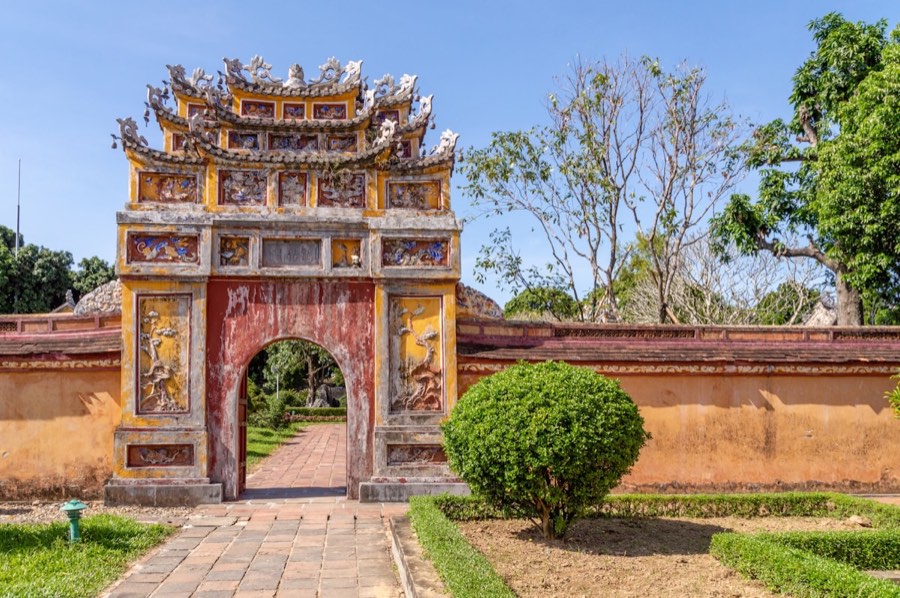
The Imperial Citadel is Vietnam’s most significant imperial architectural complex. Built from 1804 under Emperor Gia Long and expanded through the Nguyen dynasty, it remains the most intact royal complex in Southeast Asia despite substantial damage in the 1968 Tet Offensive and the Franco-Vietnamese War.
Overview and orientation
The Citadel is a walled city 10km in perimeter, divided into three concentric enclosures:
-
Kinh Thanh (Capital City): The outer enclosure - the city wall and moat that ring the entire complex. Soldiers, administrators, and civilian staff lived within these walls.
-
Hoang Thanh (Imperial Enclosure): The inner walled city containing the imperial buildings - palaces, temples, gardens, and the Noon Gate entrance. This is what most visitors mean by “the Citadel.”
-
Tu Cam Thanh (Forbidden Purple City): The innermost enclosure where the Emperor, his family, and closest attendants lived. Largely destroyed; the foundations and some restored buildings remain.
Entry
Gate: Ngo Mon (Noon Gate) - the main southern entrance, a multi-storey gatehouse that served as the ceremonial entrance for imperial processions.
Tickets: ₫200,000 ($8) for the Imperial Enclosure including the Forbidden Purple City. The outer Kinh Thanh walls are freely accessible.
Hours: 07:00–17:30 daily. Peak heat is 10:00–15:00 - morning visits are significantly more comfortable.
What to see inside
Thai Hoa Palace (Palace of Supreme Harmony): The main audience hall where the Emperor conducted formal ceremonies and received officials. The lacquered columns and painted ceiling have been restored. The most impressive interior in the complex.
Hien Lam Pavilion and Nine Dynastic Urns: The pavilion overlooks nine large bronze urns cast in 1835–1837, each representing one of the first nine Nguyen emperors. Each urn is covered in bas-relief imagery of Vietnamese landscapes, flora, and fauna.
Mieu Temple (Royal Ancestral Temple): Where the spirit tablets of Nguyen emperors are kept. The temple follows Confucian ancestor veneration practice. Quiet and often less crowded than the main palace area.
Forbidden Purple City: The innermost sanctum, largely ruined after 1968. The To Mieu Temple and Hung Mieu Temple within the grounds survived and are active worship spaces. The Thai Binh Lau (Emperor’s reading pavilion) has been restored - the smallest and most intimate space in the complex.
The Royal Theatre (Duyet Thi Duong): Vietnam’s oldest surviving royal theatre, built 1826. Now houses a museum of court arts and hosts cultural performances (₫50,000 extra, check schedule at entrance).
The damage and restoration
The Citadel was the site of fierce fighting in the 1968 Tet Offensive - US and South Vietnamese forces fought for 26 days to retake the complex from North Vietnamese troops. The damage was extensive, particularly to the Forbidden Purple City. UNESCO-supported restoration has been ongoing since the 1990s.
The mix of restored, partially-restored, and ruined sections is visible throughout. The ruins are as interesting as the restored sections for understanding the scale of what was here.
Practical notes
Photography: The Citadel is very photogenic in morning light (07:00–09:00). The golden hour on the rooftiles and the moat reflections are at their best then.
Audio guide: Available at the entrance gate. ₫80,000 ($3.20) for a device. English commentary is useful for context on the specific buildings. For a guided visit with historical context, browse Hue Imperial Citadel tours on GetYourGuide.
Time needed: Minimum 2 hours for a partial visit; 4 hours for a thorough visit. Combining with the Flag Tower and the exterior moat walk extends to a full morning.
Footwear: Comfortable walking shoes. The courtyards are large and distances between buildings are significant.
Book an Imperial Citadel Tour
Here’s how the main Hue Citadel tour options compare:
| Tour | Duration | Price (from) | Group Size | Highlights |
|---|---|---|---|---|
| Hue Imperial Citadel Guided Walking Tour | 3 hrs | from $20/person | Small group | Royal enclosure, Forbidden Purple City, Nine Dynastic Urns, English guide |
| Hue Citadel + Royal Tombs Full Day Tour | Full day | from $40/person | Group | Citadel morning, Tu Duc and Minh Mang tombs afternoon, cyclo transfer |
| Hue Full City Tour — Citadel, Tombs and Thien Mu | Full day | from $38/person | Group | Dragon boat on Perfume River, Thien Mu Pagoda, Citadel, one royal tomb |
| Hue by Cyclo — Citadel and Old City Loop | 3 hrs | from $25/person | Private | Traditional three-wheeled cyclo, Citadel gates, Dong Ba Market, riverside |
| Hue Citadel + Cooking Class Combo | Full day | from $50/person | Small group | Morning Citadel tour, afternoon market and hands-on Hue cuisine class |
Browse all Hue Citadel tours → GetYourGuide
More in Hue
- Best Hostels in Hue 2026: Budget Stays for Backpackers
- Best Hotels in Hue 2026: From Boutique to Budget Guesthouses
- Best Restaurants in Hue 2026: Bun Bo Hue, Banh Beo and Royal Cuisine
- Day Trips from Hue 2026: DMZ, Bach Ma and Hoi An
- Hue Food Guide 2026: What to Eat in Vietnam’s Imperial Capital
- Hue History 2026: Imperial Capital, French Colonialism and the Tet Offensive
- Hue Royal Tombs 2026: Khai Dinh, Tu Duc, Minh Mang Guide
- Things to Do in Hue 2026: Imperial Citadel, Royal Tombs and River Boats
- Best Hotels in Hue 2026: Best Areas and Neighbourhoods