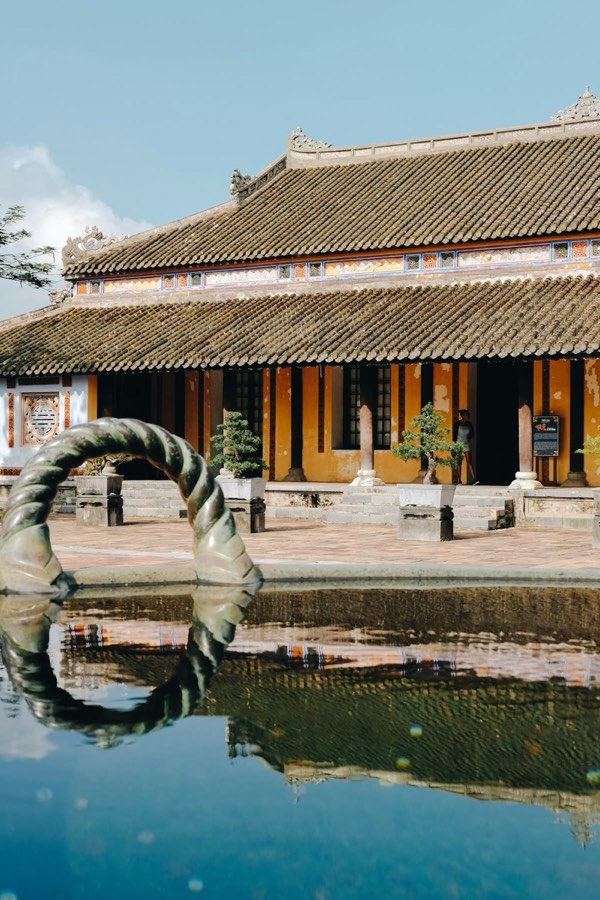
Hue has been central to Vietnamese history for over two centuries as an imperial capital, a colonial administrative centre, and the site of one of the most significant battles of the American War.
The Nguyen dynasty (1802–1945)
In 1802, Nguyen Anh unified Vietnam after decades of civil war and established the Nguyen dynasty, naming himself Emperor Gia Long. He chose Hue as the imperial capital, constructing the Citadel complex from 1804 modelled on Beijing’s Forbidden City but adapted to Vietnamese aesthetics and Confucian court culture.
The Nguyen dynasty ruled for 143 years through 13 emperors. The court developed a sophisticated culture - Vietnamese poetry, music, cuisine, and ceremony reached their highest refinement during this period. The physical legacy is the Citadel, the seven royal tombs, and dozens of imperial temples and gardens throughout the city.
Emperor Minh Mang (1820–1841): Considered the strongest Nguyen ruler. Expanded Vietnamese territory, standardised the administration, and oversaw construction of the most harmonious imperial architecture.
Emperor Tu Duc (1848–1883): The longest-reigning Nguyen emperor. A scholar and poet who built his retreat-tomb complex while still alive. His reign saw the beginning of French colonial incursion.
French Indochine (1883–1945)
France colonised Vietnam in stages from the south, taking Saigon in 1859 and gradually asserting control northward. In 1883, France imposed a protectorate over Annam (central Vietnam, with Hue as its capital) and Tonkin (the north). The Nguyen emperors became figureheads under French supervision.
The French built extensively in Hue - the colonial quarter south of the Perfume River, the administrative buildings, and the infrastructure that remains visible today. French Hue coexisted awkwardly with imperial Hue: the Citadel remained the symbolic centre but real power sat in the French Résidence across the river.
Emperor Khai Dinh (1916–1925): Controversial for his collaboration with French authority. His tomb (built during his reign) reflects French aesthetic influence - deliberately or instinctively, he embraced colonial style in his most personal monument.
Emperor Bao Dai (1926–1945): The last Nguyen emperor. Educated in France, he returned to a ceremonial role. In 1945, Ho Chi Minh’s revolutionary government declared independence. Bao Dai abdicated on August 25, 1945, formally ending the 143-year Nguyen dynasty. The abdication took place at the Noon Gate of the Imperial Citadel.
The American War and the 1968 Tet Offensive
On January 31, 1968, North Vietnamese and Viet Cong forces launched the Tet Offensive - simultaneous attacks on over 100 South Vietnamese cities. In Hue, approximately 8,000 North Vietnamese troops captured the city in a surprise assault, holding most of it for 26 days.
The Battle of Hue was the longest and most destructive battle of the Tet Offensive. US and South Vietnamese forces retook the Citadel street by street, with intense close-quarter fighting causing massive destruction to the Forbidden Purple City and significant damage throughout the Citadel.
The North Vietnamese occupation was accompanied by mass killings of South Vietnamese officials, military personnel, and civilians - estimates range from 2,800 to 6,000 killed and buried in mass graves discovered after the battle. The killings remain one of the most contested episodes of the war.
The battle is documented at the Hue Museum and in the visible damage still present in parts of the Citadel.
Post-reunification and UNESCO recognition
After 1975 reunification, Hue recovered gradually from the war damage. The Citadel and imperial sites were designated UNESCO World Heritage properties in 1993 - the first UNESCO listing in Vietnam. UNESCO funding and technical assistance has supported ongoing restoration work for over 30 years.
The city today is a major cultural heritage destination and the most intact imperial capital in Southeast Asia. Guided history tours of Hue on GetYourGuide cover the Citadel, royal tombs, and the battle history with local expert context.
More in Hue
- Best Hostels in Hue 2026: Budget Stays for Backpackers
- Best Hotels in Hue 2026: From Boutique to Budget Guesthouses
- Best Restaurants in Hue 2026: Bun Bo Hue, Banh Beo and Royal Cuisine
- Day Trips from Hue 2026: DMZ, Bach Ma and Hoi An
- Hue Food Guide 2026: What to Eat in Vietnam’s Imperial Capital
- Hue Imperial Citadel 2026: Complete Visitor Guide
- Hue Royal Tombs 2026: Khai Dinh, Tu Duc, Minh Mang Guide
- Things to Do in Hue 2026: Imperial Citadel, Royal Tombs and River Boats
- Best Hotels in Hue 2026: Best Areas and Neighbourhoods