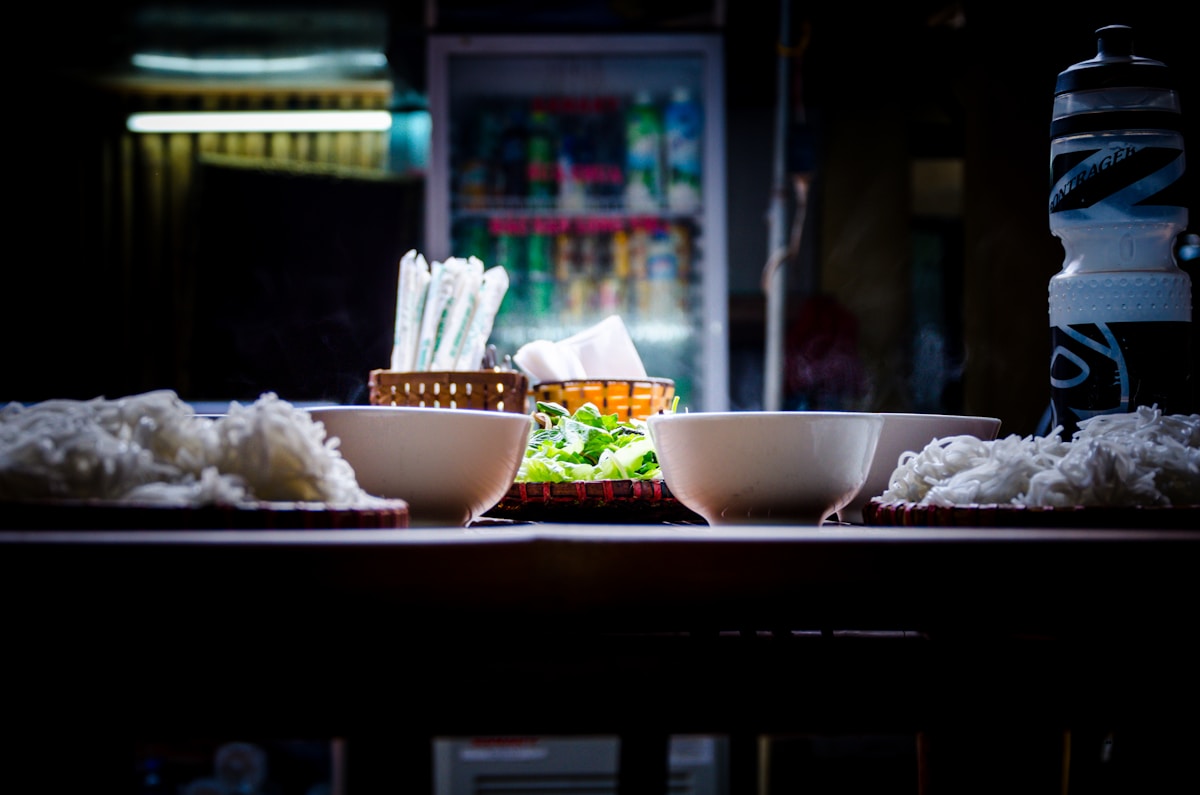
Hue’s food culture was shaped by the Nguyen imperial court. Royal chefs competed to produce dishes that demonstrated refinement through visual beauty, balance of flavours, and labour intensity. This tradition filtered down to street level - Hue street food is more complex and flavour-forward than in most Vietnamese cities.
Bun bo Hue (spicy beef noodle soup)
The most important Hue dish. Unlike pho, which is mild and clear, bun bo Hue is fiery and deeply flavoured - lemongrass, shrimp paste, and chilli give the broth a red hue and a layered intensity. Thick round rice noodles replace pho’s flat noodles. Toppings: sliced beef, pork hock, congealed blood cubes, crab paste balls.
Most Vietnamese consider bun bo Hue to be the most complex noodle broth in the country. ₫40,000–60,000 ($1.60–2.40). Best eaten before 10:00 when the stalls are freshest.
Where to eat it: Bún Bò Mụ Rớt (Vĩnh Lợi area) - the most cited local version; also Bún Bò O Xuân (near Dong Ba market) for an alternative that locals rate highly.
Com hen (rice with baby mussels)
A Hue original. Tiny hen (baby mussels from the Perfume River) are cooked and placed on cold leftover rice. A bowl of hot broth is poured over tableside. Around the bowl: raw banana blossom, bean sprouts, sesame, peanuts, shrimp crackers, and chilli. The contrast of cold rice and hot broth, crunchy textures and soft mussels, is intentional.
Sold as a breakfast dish at the small restaurants on Con Hen island. ₫30,000–50,000 ($1.20–2).
Where to eat it: Stalls around Cồn market (Chợ Cồn area), morning only, 20,000–30,000 VND - the most authentic setting for cơm hến in Hue.
Banh beo (steamed rice cakes)
Small circular rice flour cakes steamed in individual ceramic bowls and topped with dried shrimp, crunchy pork rind, and fried shallots. Eaten by scraping the cake out of the bowl with a spoon or chopstick. Always ordered in multiples - a plate of 8–12 cakes is a serving. ₫50,000–80,000 ($2–3.20) for a full set.
Where to eat it: Bánh Bèo Bà Đỏ (8 Nguyễn Bỉnh Khiêm) - a small, well-regarded specialist shop; also Lac Thien (6 Dinh Tien Hoang) which serves banh beo alongside banh khoai.
Banh loc (clear rice dumplings)
Chewy, translucent dumplings made from tapioca flour stuffed with shrimp and pork. Bright orange shrimp visible through the dumpling skin. Steamed in banana leaf. Eaten with a fish sauce and chilli dip.
Where to eat it: Lac Thien (6 Dinh Tien Hoang) - a famous family restaurant that serves banh loc alongside banh khoai and banh beo.
Banh nam (flat rice dumplings)
Similar to banh loc but flatter, wider, and wrapped in banana leaf with a different filling ratio. The banana leaf gives a subtle grassy flavour to the wrapper. Softer and more delicate than banh loc.
Where to eat it: Lac Thien (6 Dinh Tien Hoang) serves the full range of Hue small-plate dishes including banh nam, banh loc, and banh khoai.
Banh khoai (Hue pancake)
A smaller, crispier version of the southern banh xeo. A rice flour pancake fried in a small pan with shrimp, pork, and bean sprouts. Eaten wrapped in rice paper with lettuce and fresh herbs, dipped in peanut sauce. ₫30,000–50,000 ($1.20–2) per portion.
Where to eat it: Lac Thien (6 Dinh Tien Hoang) - the most famous banh khoai restaurant in Hue, a family-run institution.
Che Hue (royal sweet soups)
The Nguyen court developed an elaborate tradition of sweet soups and desserts. Che Hue refers to a range of sweet preparations - lotus seed pudding, mung bean soup, black sesame soup, and the multi-layer che ba mau. Sold from dessert stalls throughout the south bank. ₫15,000–30,000 ($0.60–1.20) per glass.
Where to eat it: Dessert stalls on the south bank of the Perfume River; Tịnh Gia Viên (9 Lê Huân) serves traditional che Hue alongside their imperial cuisine menu.
Banh mi Hue
The local version of the Vietnamese sandwich differs from Saigon-style banh mi in its heavier use of pate and a local fermented pork sausage (gio lua Hue). Sold from breakfast carts. ₫20,000–35,000 ($0.80–1.40).
Where to eat it: Breakfast carts near Dong Ba market from 06:00; La Carambole (19 Phạm Ngũ Lão) also serves a good banh mi as part of their Vietnamese menu.
Ca Phe Hue (Hue coffee)
Hue has a distinct coffee culture. Ca phe trung (egg coffee) exists here as in Hanoi, but the local preference is for strong black drip coffee served in small cups. Riverside coffee shops open early and serve until late afternoon.
Where to eat it: Riverside coffee shops along the south bank of the Perfume River; La Carambole (19 Phạm Ngũ Lão) has good coffee in a French colonial setting.
Useful links:
More in Hue
- Best Hostels in Hue 2026: Budget Stays for Backpackers
- Best Hotels in Hue 2026: From Boutique to Budget Guesthouses
- Best Restaurants in Hue 2026: Bun Bo Hue, Banh Beo and Royal Cuisine
- Day Trips from Hue 2026: DMZ, Bach Ma and Hoi An
- Hue History 2026: Imperial Capital, French Colonialism and the Tet Offensive
- Hue Imperial Citadel 2026: Complete Visitor Guide
- Hue Royal Tombs 2026: Khai Dinh, Tu Duc, Minh Mang Guide
- Things to Do in Hue 2026: Imperial Citadel, Royal Tombs and River Boats
- Best Hotels in Hue 2026: Best Areas and Neighbourhoods