Southern Vietnamese cuisine, centred on HCMC, is sweeter, more herb-forward, and more Chinese-influenced than northern cooking. Several dishes are specific to the city and the south.
Com Tam (broken rice plate)
The defining Saigon dish. Broken rice (the smaller fragments from rice milling that were historically the cheapest grade) with grilled pork chop (suon nuong), shredded pork skin mixed with toasted rice powder (bi), a steamed meatloaf (cha trung), and pickled daikon and carrot.
The combination of charred grilled pork, the dry texture of the broken rice, and the pickles is specifically Saigon. Available from the first light of dawn until after midnight. ₫35,000–70,000 ($1.40–2.80).
Where to eat it: Cơm Tấm Thuận Kiều (Bùi Thị Xuân, D1) - open from early morning, consistently good. Street stalls throughout D1 and D3 also serve it through the day.
Hu Tieu (Chinese-Vietnamese noodle soup)
The HCMC noodle soup that reflects the Chinese-Vietnamese community. Clear pork bone broth with flat rice noodles, pork slices, quail eggs, shrimp, and a large plate of fresh herbs. Unlike pho, hu tieu can be served “dry” (kho) with the broth on the side.
Particularly associated with Cho Lon (Chinatown) where Chinese-Vietnamese families have been making it for generations. ₫35,000–65,000 ($1.40–2.60).
Where to eat it: Hủ Tiếu Mỹ Tho (278 Nam Kỳ Khởi Nghĩa, D3) is well-regarded; for a Cho Lon experience, any street stall in District 5’s Chinatown from early morning.
Banh Mi Saigon
The Saigon banh mi uses a lighter, crispier baguette than the Hanoi equivalent. Standard fillings: pate, butter, Vietnamese sausage (cha lua), grilled pork (xa xiu), cucumber, pickled vegetables, fresh coriander, spring onion, and sauce. The generosity of filling is characteristic. ₫25,000–50,000 ($1–2).
Where to eat it: Bánh Mì Huỳnh Hoa (26 Lê Thị Riêng, D1) - the most famous bánh mì in Saigon, with long queues and very generous portions. Worth the wait. Also Bánh Mì Phượng has an HCMC branch.
Bun Thit Nuong (grilled pork vermicelli)
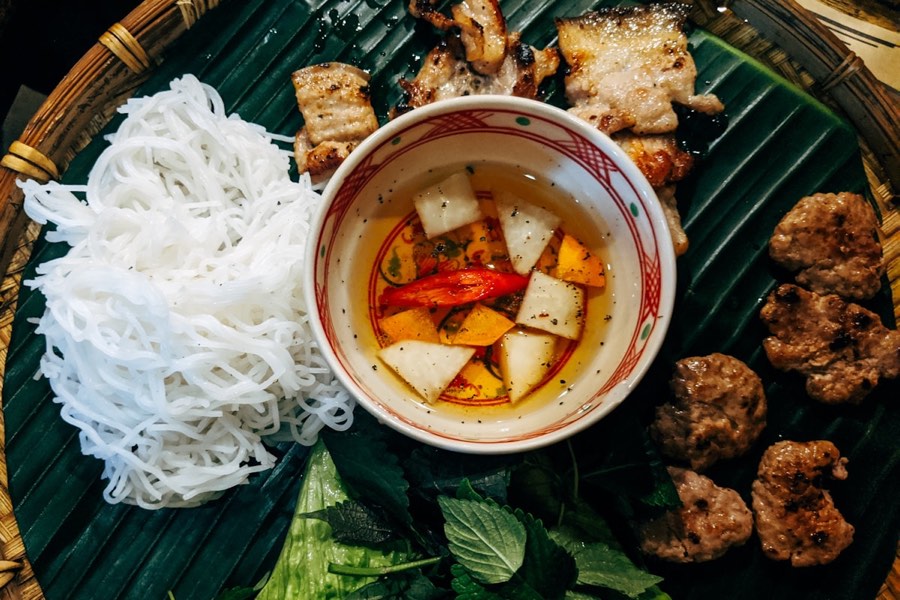
Cold rice vermicelli with sliced charcoal-grilled pork (often with lemongrass seasoning), crushed peanuts, fried shallots, cucumber, pickled vegetables, fresh mint and herbs. Dressed with a light fish sauce and lime dressing. A refreshing, herb-heavy dish for the southern heat. ₫30,000–55,000 ($1.20–2.20).
Where to eat it: Bún Bò Huế Bà Tuyết (9 Ngô Thị Thu Minh, D3) specialises in central Vietnamese noodle dishes including bún thịt nướng; Ngon Restaurant (160 Pasteur, D3) is a good introduction with many dishes on one menu.
Banh Xeo (sizzling pancake)
The HCMC version is very large - the pancake fills a complete plate. Turmeric rice flour batter fried with shrimp, pork, and bean sprouts. Eaten wrapped in mustard leaf and rice paper with fresh herbs, dipped in a sweetened fish sauce.
Where to eat it: Ngon Restaurant (160 Pasteur, D3) serves a reliable banh xeo alongside a broad Vietnamese menu - good for trying multiple dishes. Street stalls in D1 also serve it from lunchtime onward.
Ca Phe Sua Da (iced Vietnamese coffee)
The essential drink. Strong Robusta drip coffee through a metal phin filter over sweetened condensed milk and ice. HCMC has hundreds of ca phe sua da street stalls. ₫15,000–30,000 ($0.60–1.20) at street level, ₫30,000–55,000 ($1.20–2.20) at sit-down cafes.
Where to eat it: Any street stall throughout the city; Ngon Restaurant (160 Pasteur, D3) or the cafes on Pasteur Street in D1 for a sit-down version.
Nuoc Mia (fresh sugarcane juice)
Fresh sugarcane pressed through a machine with a slice of kumquat and ice. Sold from street carts throughout the city. ₫15,000–25,000 ($0.60–1) per glass. The best refreshment in HCMC’s heat.
Where to eat it: Street carts throughout D1 and the Ben Thanh Market area - buy from any cart with visible juice-pressing activity.
Bo Bia (Vietnamese spring roll)
A street snack specific to southern Vietnam. A thin rice paper roll filled with Chinese sausage, dried shrimp, jicama (yam bean), fried egg, and fresh herbs. Cold and crunchy. Sold from street carts and market stalls. ₫5,000–15,000 ($0.20–0.60) per roll.
Where to eat it: Street carts near Ben Thanh Market and in Cho Lon (Chinatown, D5); Ngon Restaurant (160 Pasteur, D3) includes gỏi cuốn (fresh spring rolls) and bo bia on its menu as part of a broader southern Vietnamese spread.
Useful links:
More in Ho Chi Minh City
- Best Cafes to Work in Ho Chi Minh City 2026: Coworking and Wifi Cafes
- Best Hostels in Ho Chi Minh City 2026: Pham Ngu Lao Budget Stays
- Best Hotels in Ho Chi Minh City 2026: From Luxury to Budget
- Best Restaurants in Ho Chi Minh City 2026: Com Tam, Pho and Street Food
- Ho Chi Minh City Coffee Guide 2026: Ca Phe Sua Da and Specialty Cafes
- Cu Chi Tunnels 2026: Complete Visitor Guide from Ho Chi Minh City
- Day Trips from Ho Chi Minh City 2026: Mekong Delta, Cu Chi and More
- Getting Around Ho Chi Minh City 2026: Grab, Motorbike and Metro
- Ho Chi Minh City History 2026: Saigon from French Colony to Reunification
- Ho Chi Minh City Nightlife 2026: Rooftop Bars, Bui Vien and Clubs
- Things to Do in Ho Chi Minh City 2026: War History, Markets and Street Food
- Vegan Food in Ho Chi Minh City 2026: Com Chay and Vegan Cafes
- Best Hotels in Ho Chi Minh City 2026: Best Districts for Visitors