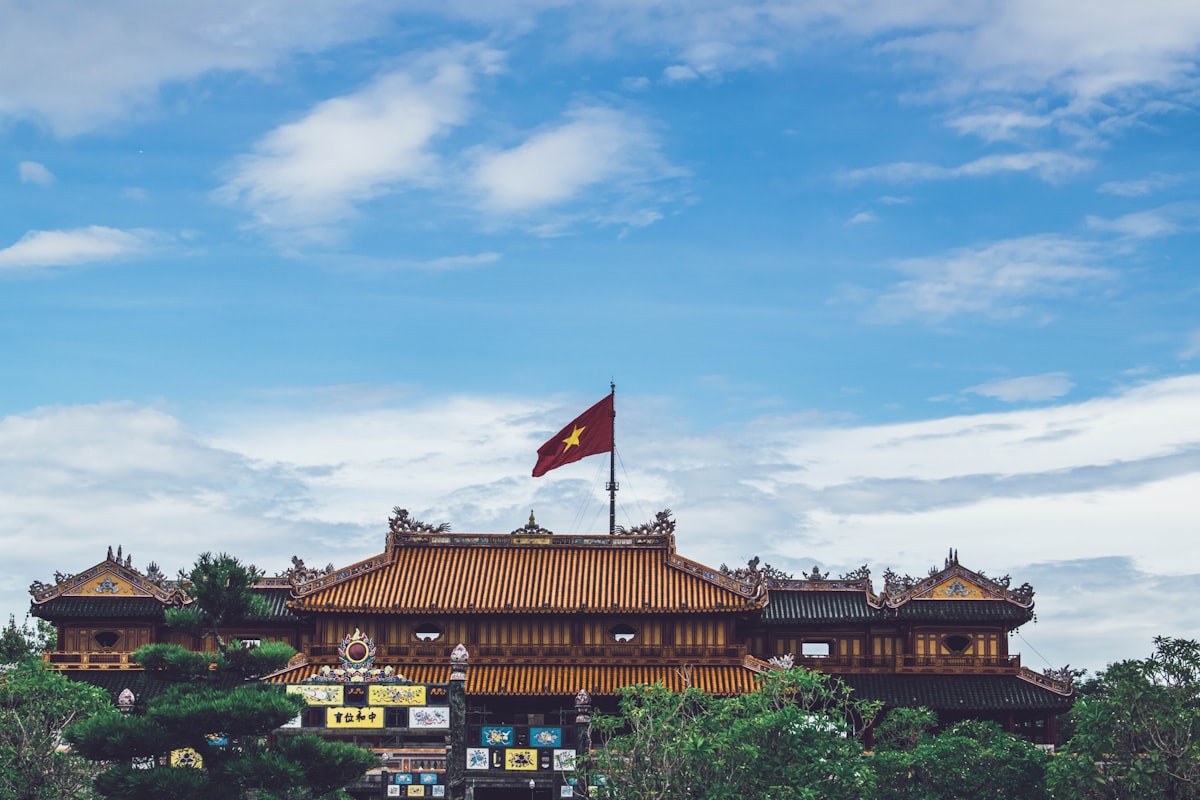
Hue, Vietnam’s last imperial capital, was the seat of the Nguyen Dynasty from 1802 to 1945. The dynasty - thirteen emperors across 143 years - built an elaborate imperial complex modelled on Beijing’s Forbidden City but adapted to Vietnamese cosmological and feng shui principles: positioned on the south bank of the Perfume River (Song Huong) with Ngu Binh Mountain behind it, the complex was oriented to face the river and the distant sea.
What survives today is significant but incomplete. The Tet Offensive of January 1968 and the Battle of Hue that followed - one of the longest and most destructive urban battles of the Vietnam War - destroyed large sections of the Imperial Enclosure. The Forbidden Purple City (Tu Cam Thanh), the innermost compound where the emperor and his family lived, was almost entirely levelled. Ongoing restoration has been underway since the 1990s, funded by UNESCO and the Vietnamese government.
A tour of Hue’s imperial monuments is therefore as much a history of twentieth-century war as it is of nineteenth-century royal architecture.
Top Tours at a Glance
Here’s a quick comparison of top-rated tours on GetYourGuide:
| Tour | Duration | Price (from) | Group Size | Highlights |
|---|---|---|---|---|
| Hue Imperial City Walking Tour | 3 hrs | from $18/person | Group | Citadel, Thai Hoa Palace, Forbidden Purple City |
| Imperial City + 2 Royal Tombs Full Day | 7–8 hrs | from $28/person | Small group | Citadel, Minh Mang & Khai Dinh tombs, transport |
| Private Hue City Tour with Guide | 7–8 hrs | from $45/person | Private | Custom itinerary, private car, licensed guide |
| Hue + DMZ Full-Day Tour | 10–12 hrs | from $35/person | Group | Vinh Moc tunnels, Khe Sanh, Hien Luong Bridge |
| Hue Cyclo & Imperial City Tour | 4 hrs | from $22/person | Small group | Traditional cyclo, old city streets, citadel exterior |
Browse all Hue tours → GetYourGuide
The Imperial Enclosure (Hoang Thanh / Dai Noi)
The outer walls of the Imperial Enclosure measure 2.5 km per side - a walled rectangle enclosing the throne hall, ceremonial pavilions, temples, libraries, and the ruined Forbidden Purple City at the centre. Entry is through the Ngo Mon Gate (Noon Gate), a five-arched imperial gate topped by the Five Phoenix Pavilion - the structure where Bao Dai, the last Nguyen emperor, abdicated to Ho Chi Minh’s provisional government on 25 August 1945.
What to see inside:
- Thai Hoa Palace (Palace of Supreme Harmony): The throne hall, built in 1805 and restored after wartime damage. The central hall contains the imperial throne; the ceiling is decorated with 128 dragons and clouds. Ceremonial court was held here on major occasions. Open daily.
- Hien Lam Pavilion and Nine Dynastic Urns (Cuu Dinh): Nine massive bronze urns cast between 1835 and 1836, each bearing intricate reliefs of Vietnamese landscapes, animals, plants, and astronomical phenomena. Each urn weighs 1,500 to 2,600 kg and is dedicated to a different Nguyen emperor.
- The Mieu Temple: The ancestral temple where Nguyen emperor tablets are kept and worshipped. Still an active religious site; remove shoes before entering.
- Forbidden Purple City ruins: The bombed-out inner compound where the emperor lived. Most structures were destroyed in 1968; what remains gives the most direct sense of the battle’s scale. The excavated foundations and remaining gates are compelling to walk through.
Tickets: Approximately 200,000 VND per person for the Imperial Enclosure alone as of 2026. The combined ticket (360,000 VND) adds access to two royal tombs.
Opening hours: 7am to 5:30pm daily. The site is large and hot; morning visits are more comfortable.
Royal Tombs (~150,000 VND each)
The Nguyen emperors built elaborate funerary complexes in the hills south of Hue, typically during their own lifetimes. Three are most commonly visited:
Minh Mang Tomb (~10 km from Hue, 30 minutes by bicycle): The largest and most formally symmetrical of the royal tombs, designed by Emperor Minh Mang himself and completed by his successor in 1843. Set in 28 hectares of forested landscape around a lake, with a long processional avenue of stone mandarins, horses, and elephants leading to the main stele pavilion. The most architecturally impressive of the three.
Khai Dinh Tomb (~12 km from Hue): Built 1920–1931 by the third-to-last Nguyen emperor in an unusual style that blends Baroque European architecture with traditional Vietnamese elements. Mosaic tile murals cover every interior surface. Set on a hillside with 127 steps to the tomb chamber. Often cited as the most visually striking of the royal tombs; also the smallest.
Tu Duc Tomb (~7 km from Hue): Built by Emperor Tu Duc from 1864 as his personal retreat and eventual tomb. The largest complex, spread across 12 hectares with a lake, guest pavilions, a library, and the emperor’s personal living quarters - he reportedly spent considerable time here composing poetry. More romantically overgrown than Minh Mang or Khai Dinh and popular for photography.
Getting to the tombs: By bicycle from central Hue (20–40 minutes depending on the tomb); by motorbike taxi (~30,000–50,000 VND per tomb); or by tour. A half-day tomb tour by car visiting two or three sites costs approximately 200,000–350,000 VND per person.
Guided Tour Options
GetYourGuide Hue Imperial City tours - full-day guided tours covering the Imperial Enclosure and two royal tombs, with transport and an English-speaking guide, from approximately USD 20–35 per person as of 2026. Half-day options focusing on just the Imperial Enclosure are available from USD 15 per person.
Hue City Cyclo Tour - a slower, more atmospheric option that covers the old city, the Imperial Enclosure exterior, and the Thien Mu Pagoda by cyclo (the traditional three-wheeled rickshaw). Approximately USD 18–25 per person for a half-day circuit. Available via GetYourGuide.
Private guided tours of the Imperial Enclosure: Hire a licensed guide directly at the Ngo Mon Gate for approximately 200,000–300,000 VND per hour (negotiate before entering). Private guides often provide more detailed historical context than group tour guides.
DMZ Add-On (Demilitarized Zone)
The DMZ - the former military border between North and South Vietnam at the 17th Parallel, approximately 90 km north of Hue - is bookable as a day add-on from Hue. A full-day DMZ tour typically covers:
- Ben Hai River and Hien Luong Bridge: The exact crossing point that divided the country from 1954 to 1975
- Vinh Moc Tunnels: A civilian tunnel complex north of the DMZ built by villagers to escape US bombing; less visited than Cu Chi and more intact
- The Rockpile and Khe Sanh Combat Base: Sites of the 77-day siege of 1968; the former American airstrip and firebase ruins remain
- Doc Mieu Firebase: A former US and South Vietnamese artillery position overlooking the DMZ
DMZ day tours from Hue run approximately USD 25–40 per person on a shared basis, approximately USD 80–120 for a private car with guide. Depart at 7–8am, return by 6–7pm.
Thien Mu Pagoda (Pagoda of the Celestial Lady)
Strictly speaking a separate site from the Imperial Complex, but included in most Hue itineraries. The seven-storey Thien Mu Pagoda on the Perfume River (3 km west of the Imperial Enclosure) is the oldest religious building in Hue and widely considered the symbol of the city. The tower dates to 1601; the bronze bell cast in 1710 weighs 2,052 kg and can reportedly be heard 10 km away. The pagoda is an active monastery - dress modestly and remove shoes before entering any shrine.
Combine the pagoda with a 30-minute Perfume River boat tour (negotiate with boat operators at the riverbank for approximately 100,000–200,000 VND per hour for a private boat) to see the pagoda from the water as the imperial court once would have.
Practical Information
Getting to Hue: Hue is 670 km south of Hanoi (1.5 hours by flight, approximately 12–14 hours by train) and 110 km north of Da Nang (2 hours by train or 3 hours by road). The scenic Hai Van Pass road between Da Nang and Hue is one of Vietnam’s most dramatic drives.
Best time to visit: Hue is rainiest from October to January - the wettest months in central Vietnam. February to August is drier. The Imperial Enclosure is most photogenic in morning light (7–10am) before crowds build.
Getting around Hue: Bicycle (30,000–50,000 VND per day rental, widely available near the Imperial Enclosure) is the most practical way to combine the city centre with the southern tombs if the weather cooperates. Taxis and Grab are available for all distances.
Book Hue tours:
- Tours and activities in Hue via GetYourGuide