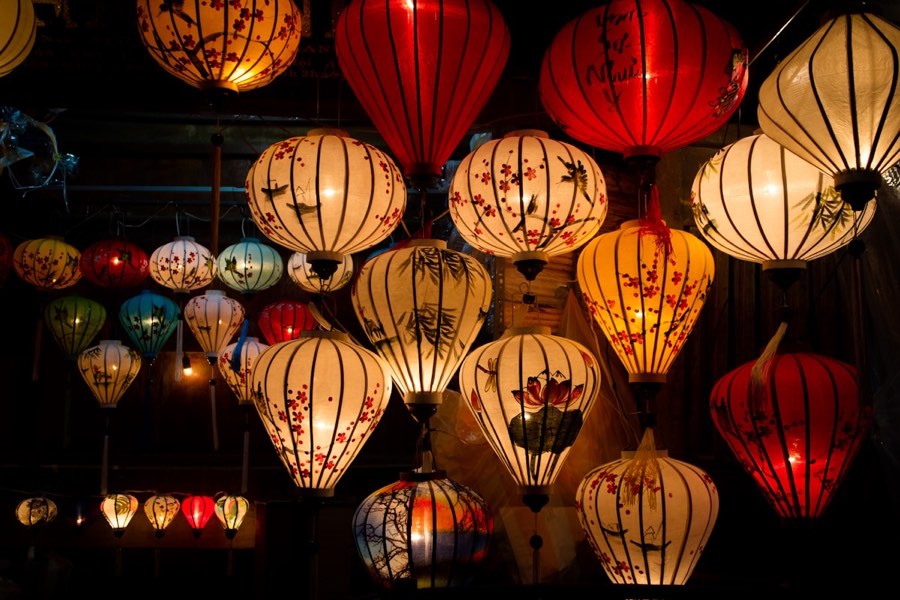
On the 14th day of each lunar month, Hoi An’s Ancient Town transforms. Electric lights go off across the old quarter. Silk and paper lanterns take over every street, balcony, and boat. The Thu Bon River fills with floating candles, and the town’s 400-year-old streets look closer to 1600 than the present day. This is the Full Moon Lantern Festival, and it happens every single month.
Top Tours at a Glance
| Tour | Duration | Price (from) | Group Size | Highlights |
|---|---|---|---|---|
| Hoi An Lantern Boat Ride & Release | 1–1.5 hrs | from $8/person | Up to 8 | Thu Bon River boat, drooping flower lanterns, departs Bach Dang Street |
| Da Nang/Hoi An Coconut Boat & Lantern Festival | 5 hrs | from $28/person | Small group | Hotel pickup Da Nang, coconut forest, basket boat, Fukian Assembly Hall, lantern release |
| Hoi An Night Street Food & Lantern Boat | 3 hrs | from $22/person | Max 10 | Ancient town walk, authentic street food tasting, lantern boat on Thu Bon |
| Lantern Release & Night River Boat Experience | 1.5 hrs | from $10/person | Small group | Flower lantern release, river boat circuit, Bach Dang Street departure |
| Private Lantern Festival Night Walk + Boat | 2.5 hrs | from $35/couple | Private | Hotel pickup in old quarter, guided walk, private rowboat, foot massage add-on available |
Browse all Hoi An lantern festival tours → GetYourGuide
What the Festival Is
The Full Moon Lantern Festival (Tet Nguyen Tieu in Vietnamese) is a monthly tradition rooted in both Chinese merchant heritage and Vietnamese folk practice. Hoi An’s large Chinese trading community historically observed the 15th day of the lunar calendar, and the town has kept the practice alive in a form that blends spiritual custom with community celebration.
Each month on the 14th lunar day (the evening before the full moon), the old quarter along Tran Phu, Nguyen Thai Hoc, and Bach Dang streets switches off electric lights from approximately 7:00 pm to 10:00 pm. Vendors line the riverbanks with lanterns, food stalls, and candles. Boats push off into the Thu Bon with passengers releasing floating paper lanterns. Traditional music plays from small stages around the ancient town.
The annual Hoi An Lantern Festival, usually held in October or November, is a separate, larger event with performances, competitions, and street markets. It draws significantly larger crowds. The monthly festival is the one most visitors experience, and it is worth planning your Hoi An dates around it.
When It Happens
The 14th day of the lunar calendar falls on a different Gregorian date every month. As a general pattern in 2026, festival nights fall roughly mid-month: mid-January, mid-February, and so on. Vietnamese calendar apps and the Hoi An tourism website publish exact dates. The festival is never cancelled for weather, though heavy rain dampens the lantern floats.
The months from October through March offer the best atmosphere. Temperatures are cooler, crowds are higher, but the air is clearer and the lanterns photograph better. July and August are hot and humid, and the festival still runs but feels more compressed as heat keeps people moving faster.
Best Spots to Watch and Participate
Thu Bon River banks (Bach Dang Street) - The riverfront between the Japanese Covered Bridge and Nguyen Hoang Bridge is the festival’s centre of gravity. Vendors sell paper lanterns, candles, and incense from small tables starting around 6:00 pm. This is where you light a lantern, set it on the water, and watch it drift downstream. The view from the bank looking toward the old town, with lanterns glowing on the water, is the festival’s iconic image.
Japanese Covered Bridge (Lai Vien Kieu) - The bridge itself is illuminated with paper lanterns on festival nights. It gets crowded quickly after dark, but arriving by 6:30 pm gives you time to walk across before the crowd peaks. The view from either bank, looking toward the bridge with its lantern-lit facade, is one of the best in the old town.
Nguyen Hoang Bridge - The newer footbridge crossing the Thu Bon, east of the Japanese Covered Bridge, gives a clear sightline back toward the old town and the river full of floating lights. Less congested than Bach Dang Street, and a good spot if you want photographs without elbowing for position.
Nguyen Thai Hoc and Tran Phu streets - The main commercial streets through the ancient town are fully pedestrianised and lantern-lit on festival nights. Walking these streets without the usual motorbikes and tuk-tuks, with lanterns overhead and candles at doorways, is a different version of Hoi An entirely.
How to Participate
Buy lanterns from riverside vendors. Paper lanterns in round, lotus, and star shapes cost approximately 20,000 to 50,000 VND each (around USD 1 to 2 as of 2026). The vendor lights a small candle inside and the lantern floats when you set it on the water. The tradition carries a wish or prayer with it, though you do not need to follow any particular ritual.
Take a boat ride on the Thu Bon. This is the most atmospheric way to experience the festival. Small wooden boats depart from Bach Dang Street throughout the evening and carry four to eight passengers. Rides typically last 20 to 40 minutes and cost approximately 150,000 to 200,000 VND per person (around USD 6 to 8 as of 2026). From the water, you release lanterns and watch the rest float past from other boats and the banks. Agree on the price before boarding.
Arrive by 6:00 pm. The ancient town fills quickly after dark. Coming early lets you walk the main streets while they are quiet, buy lanterns without competing for a spot on the bank, and board a boat without a long wait. The atmosphere peaks between 7:30 pm and 9:30 pm.
Plan for at least two hours. One hour is enough to walk the main streets and release a lantern. Two hours lets you take a boat ride, explore quieter alleys, and eat at one of the riverside restaurants. The festival is technically over by 10:00 pm when electric lights return, though vendors wind down gradually.
Guided Tour vs Self-Guided
The festival is easy to do independently — buy a lantern from a riverside vendor (20,000 to 50,000 VND), walk the old quarter streets, and board a boat from Bach Dang Street. No guide is required for the basic experience.
Guided evening tours add value if you want context on the history and traditions, or if you are arriving from Da Nang and want transport included. Most festival tours run three to four hours and combine the lantern release with a walk through the ancient town and a boat ride.
Vietnam Backpacker Hostels (Hoi An branch) runs a popular group lantern tour most months for approximately USD 15 to 20 per person, including transport from their hostel, a guide, and one lantern per person.
Hoi An Eco Tours offers private lantern evenings with a local guide and boat included for approximately USD 35 to 50 per person, depending on group size. Their boats are smaller traditional wooden vessels that depart from a quieter stretch of the river, away from peak crowd areas.
Klook lists several independently operated Hoi An lantern festival night tours from around USD 18 to 30 per person. These vary by operator but typically include hotel pickup within the Hoi An old quarter, a guided walk, and a river boat ride. Filtering by review count and review score on Klook’s listings is a reliable way to identify the better-run options.
Booking a tour from Da Nang is worth considering if your accommodation is there. Several operators run full-day Da Nang to Hoi An packages that include the festival evening, removing the need to arrange return transport yourself at peak hour.
Getting to Hoi An from Da Nang
Da Nang is the nearest major airport and transport hub, approximately 28 km north of Hoi An. Taxis and private cars take 30 to 45 minutes depending on traffic and cost approximately 200,000 to 300,000 VND (around USD 8 to 12 as of 2026). Grab (the regional ride-hailing app) is available from Da Nang and gives you a fixed price before you book.
Book your return transport before you go. Festival nights push demand sharply upward after 9:00 pm as crowds leave at once. Pre-booked private transfers from Da Nang Airport to Hoi An and back are the most reliable option and remove the uncertainty of finding a ride at 10:00 pm.
Practical Tips
Book accommodation early for the annual festival. The monthly Full Moon Festival does not require advance booking for hotels in most months. The annual Hoi An Lantern Festival in October or November is a different story - hotels in the old quarter sell out weeks in advance and prices roughly double.
Bring cash. Lantern vendors, boat operators, and most street food stalls on festival nights are cash only. ATMs on Le Loi Street and Phan Chu Trinh Street are the closest to the ancient town.
Wear light clothing. Even in cooler months, festival crowds generate heat. Comfortable walking shoes matter more than a jacket.
Leave the motorbike outside the ancient town. The old quarter is pedestrianised on festival nights, and parking fills up fast in surrounding streets. Walk or drop off by taxi on the edge of the old town.
The Hoi An Lantern Festival is one of the most straightforward travel experiences in Vietnam: it costs almost nothing to participate, happens every month, and looks exactly as good in person as it does in photographs.