Hue and Hoi An are two of Vietnam’s most rewarding cities, separated by 120 km of central Vietnamese coastline and a mountain pass that is itself one of the country’s great drives. They are almost always visited together, and rightly so - but they attract different types of travellers, reward different kinds of attention, and leave different impressions.
Hue is Vietnam’s imperial capital - serious, layered, and historically dense. Hoi An is Vietnam’s romantic old town - photogenic, food-obsessed, and lantern-lit. Both deserve time. Here’s how to allocate it.
Setting and Atmosphere
Hue sits on the banks of the Perfume River (Song Huong) behind a massive moated citadel. It was the seat of the Nguyen Dynasty (1802–1945) - Vietnam’s last imperial rulers - and the capital of a unified Vietnam for 143 years. The city carries that gravity: quieter than Hanoi or Ho Chi Minh City, less fashionably pretty than Hoi An, but with a cultural weight that is substantial.
Walking the streets of Hue feels different from Vietnam’s other cities. The pace is slower, locals are less attuned to tourist rhythms, and the food - Hue’s royal cuisine - is taken extraordinarily seriously. Hue women are considered among Vietnam’s most elegant cooks.
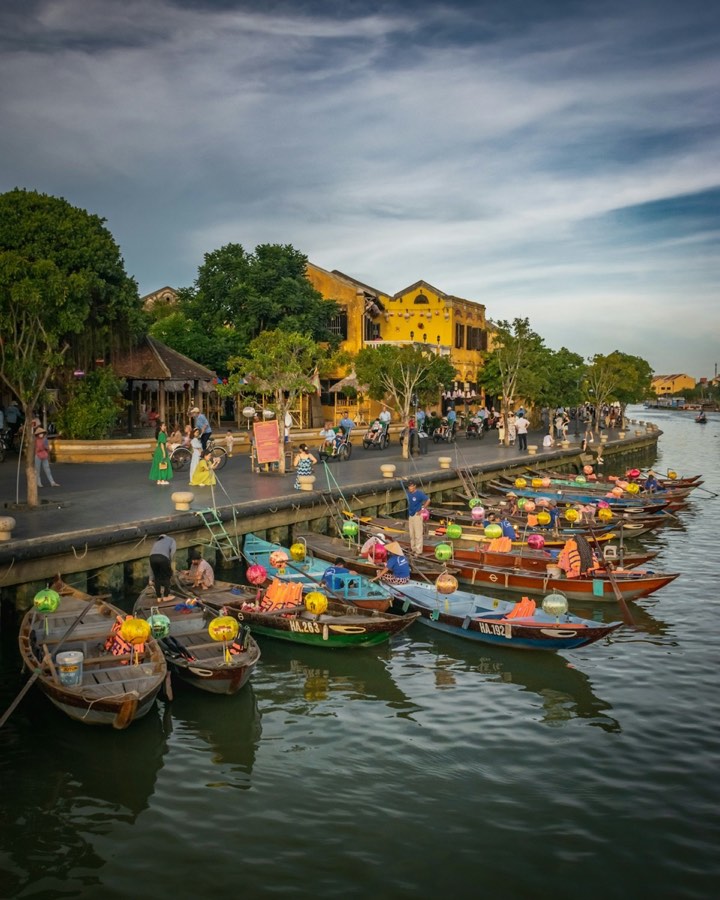
Hoi An is Vietnam’s most immediately beautiful small city. The Ancient Town’s pastel-yellow merchant houses, red lanterns strung across narrow streets, and the Thu Bon River with its wooden boats create a setting that photographs itself. The city was a major port from the 15th to 19th centuries, shaped by Japanese, Chinese, and Vietnamese merchant communities - each left visible traces in the architecture.
The atmosphere in Hoi An is deliberately preserved and somewhat stagey. This is a UNESCO site that knows it’s a UNESCO site. Evenings - when the paper lanterns are lit and motorised vehicles are banned from the old town - are genuinely magical. The city is at its best after 5 p.m. when day-trip crowds from Da Nang thin out.
Historical Sites
Hue
The Imperial Citadel (Kinh Thanh Hue) is the central experience. Built between 1804 and 1833, it contains the Forbidden Purple City (the emperor’s inner sanctum), the Mieu Temple complex, and numerous gates and pavilions. Much was damaged in the 1968 Tet Offensive; restoration is ongoing. Admission is VND 200,000 (approximately USD 8 as of 2026). Plan three to four hours minimum.
The Royal Tombs of the Nguyen emperors are scattered across the hillsides south of the city, each a distinct complex of pavilions, lakes, and mausoleums reflecting the emperor’s personality. The Tomb of Tu Duc (the most elaborate, built 1864–1867) and Minh Mang (formal and symmetrical) are the two most visited. Each costs VND 150,000–200,000 entry. Hiring a bicycle to visit two or three tombs in a day is the standard approach.
Thien Mu Pagoda, 4 km from the city centre on the Perfume River, is Hue’s most recognisable symbol - a seven-storey octagonal tower dating from 1601, still an active monastery.
Hoi An
The Ancient Town entry ticket (VND 120,000, approximately USD 5) covers five heritage site visits - choose from the Japanese Covered Bridge, various assembly halls (Fujian, Cantonese, Chaozhou), and merchant houses. The Japanese Covered Bridge (1590s, arguably Vietnam’s most photographed structure) connects the Japanese and Chinese merchant quarters. The Tan Ky Ancient House is the best-preserved merchant dwelling, with 200 years of family occupation visible in its layers of Japanese, Chinese, and Vietnamese decorative styles.
The My Son Sanctuary (45 km southwest, approximately USD 15 day trip) contains the best-preserved Cham temple ruins in Vietnam - a 4th–13th century Hindu temple complex partially destroyed by US bombing in 1969 but still impressive in what remains.
Food
This comparison is between two of Vietnam’s greatest food cities, and neither will disappoint.
Hue’s Cuisine
Hue’s royal cuisine tradition developed to satisfy the tastes of 13 emperors - dishes were elaborate, small in portion, and visually as important as flavourful. The street food legacy of this tradition: dozens of small, inexpensive dishes available from stalls around Dong Ba Market and the old town’s alleyways.
Bun bo Hue - spicy lemongrass and beef noodle soup with thick rice noodles - is the city’s signature and among Vietnam’s finest noodle dishes. USD 2–3 at local shops. Banh khoai (crispy fried crepe filled with shrimp, pork, and bean sprouts) with a distinctive peanut and sesame dipping sauce. Com hen (rice with tiny river mussels, herbs, peanuts, and chilli) is a breakfast eaten cold - challenging for newcomers, one of Hue’s more interesting dishes. Bun thit nuong (vermicelli with grilled pork and fresh herbs) is the lighter lunchtime staple.
Hoi An’s Cuisine
Hoi An’s food identity is tied to specific local products and techniques: cao lau noodles (thicker than most, with a texture unique to noodles made using water from local Cham wells), white rose dumplings (banh bao vac, see-through steamed dumplings with shrimp, only made by one family in Hoi An), and freshly made banh mi from the Phuong and Madam Khanh stalls that both claim the title of best in town.
The Hoi An Central Market runs from pre-dawn: buy com ga (chicken rice) at 6 a.m. from women who set up before the tourists arrive. The market also sells cao lau noodles, fresh herbs, and ingredients from the surrounding farms.
Cooking classes are a Hoi An industry - Morning Glory and Red Bridge are the most established operators (USD 30–35 per person for a half-day class including market tour and three dishes). They’re worth doing once.
Cost
Both cities are among Vietnam’s more affordable, with Hue slightly cheaper overall.
Accommodation in Hue:
- Budget guesthouse: USD 12–22/night
- Mid-range hotel: USD 35–70/night (the La Residence Hotel & Spa, in a converted French governor’s mansion on the Perfume River, is the most atmospheric choice at USD 100–180)
Accommodation in Hoi An:
- Budget near Ancient Town: USD 20–35/night (proximity premium)
- An Bang Beach area: USD 18–28/night
- Mid-range boutique: USD 50–100/night (Anantara Hoi An, La Siesta)
Food in both cities: street meals USD 2–4, restaurants USD 6–15 per head.
Sites: Hue’s Imperial Citadel + Royal Tombs budget USD 20–30 for two days of serious visiting. Hoi An’s Ancient Town ticket is USD 5.
Getting Between Them
The Hai Van Pass route (Đèo Hải Vân) between Da Nang and Hue is one of the most scenic drives in Vietnam: the road climbs over a forested mountain headland with views over Da Nang Bay to the south and Lang Co Lagoon to the north. The 20 km pass takes about 45 minutes to drive. Many travellers hire a motorbike (USD 7–10 per day) or book a private car for this stretch. A direct tourist bus from Hoi An to Hue (via Da Nang) takes 3–4 hours and costs USD 6–10.
The train between Da Nang and Hue (45 minutes, USD 4–8) crosses the pass through a tunnel for most of the route, but windows still give glimpses of coastline. The section over the pass is visible from certain train carriages and worth the seat selection. Book tickets at Da Nang or Hue stations.
Best For
Choose Hue as your primary stop if:
- Imperial history and the Nguyen Dynasty is a serious interest
- You want to explore royal tombs and a large-scale citadel
- Hue’s royal food tradition and smaller, more intense dishes appeal
- A quieter, less touristed atmosphere suits your pace
Choose Hoi An as your primary stop if:
- Atmosphere, photography, and an “old town feel” are the main draws
- Cooking classes and market visits are on your list
- Beach access (An Bang or Cua Dai) matters
- You’re combining with Da Nang and Ba Na Hills
The Verdict
Both cities deserve two nights minimum, ideally three. For a first visit to central Vietnam, Hoi An is the more immediately appealing experience and the one that photographs into memory more easily. Hue requires a little more engagement but rewards travellers who give it time: a dawn visit to the citadel, an afternoon cycling to the Royal Tombs, an evening eating com hen on a plastic stool on Dong Ba Market’s edge.
Do both. Take the Hai Van Pass between them.
See our detailed guides to Hoi An and Hue for specific neighbourhood and restaurant recommendations. To book tours, cooking classes, and day trips in either city, browse Hoi An tours and Hue tours.
Plan Your Trip
✈️ Book your flights to Vietnam 🛡️ Get travel insurance 📱 Stay connected with an eSIM 🚗 Rent a car