Mui Ne sits at the edge of a long curved bay that catches some of the best seafood in southern Vietnam. The village behind the resort strip is still a working fishing community — the round basket boats (thung chai) go out before dawn, and by 7am the catch is already being unloaded at the Phan Thiet fish market. This proximity to the sea shapes everything about eating here. Fish sauce made in Phan Thiet (the nearest town) is among the finest in Vietnam. The clams, squid, crab, shrimp and fresh fish at beach restaurants are not decorative menu items — they were swimming nearby yesterday.
This guide covers the dishes most worth trying, the local spots that cook them best, and a frank look at the beach restaurant scene.
The Local Dish to Know: Banh Canh Cha Ca
If you eat one thing in Mui Ne that you cannot find anywhere else with the same quality, make it banh canh cha ca. This is thick, glutinous rice noodle soup made with fish cake — cha ca, which in the Phan Thiet style means steamed or grilled patties of freshwater or saltwater fish, seasoned with turmeric and fish sauce. The broth is clear, light and deeply savoury, seasoned with the fish cooking liquid and finished with spring onion and fried shallots. Toppings typically include sliced fish cake, sometimes whole pieces of grilled fish, and a tangle of the slippery thick noodles.
It bears some resemblance to banh canh cua (crab version, common in Saigon) but the Phan Thiet fish cake version has its own character — more delicate and less fatty than crab. A bowl costs approximately 30,000–50,000 VND at a local stall (as of 2026).
Where to eat it: Quan Banh Canh Cha Ca on Huynh Thuc Khang Street in Mui Ne village (the section of the main road closer to the fishing harbour, away from the resort strip). Open from around 6am until sold out, usually by 11am. Several similar stalls operate within a 200-metre radius — look for the plastic stools and the ceramic soup bowls stacked in towers.
Bun Ca: Fish Noodle Soup
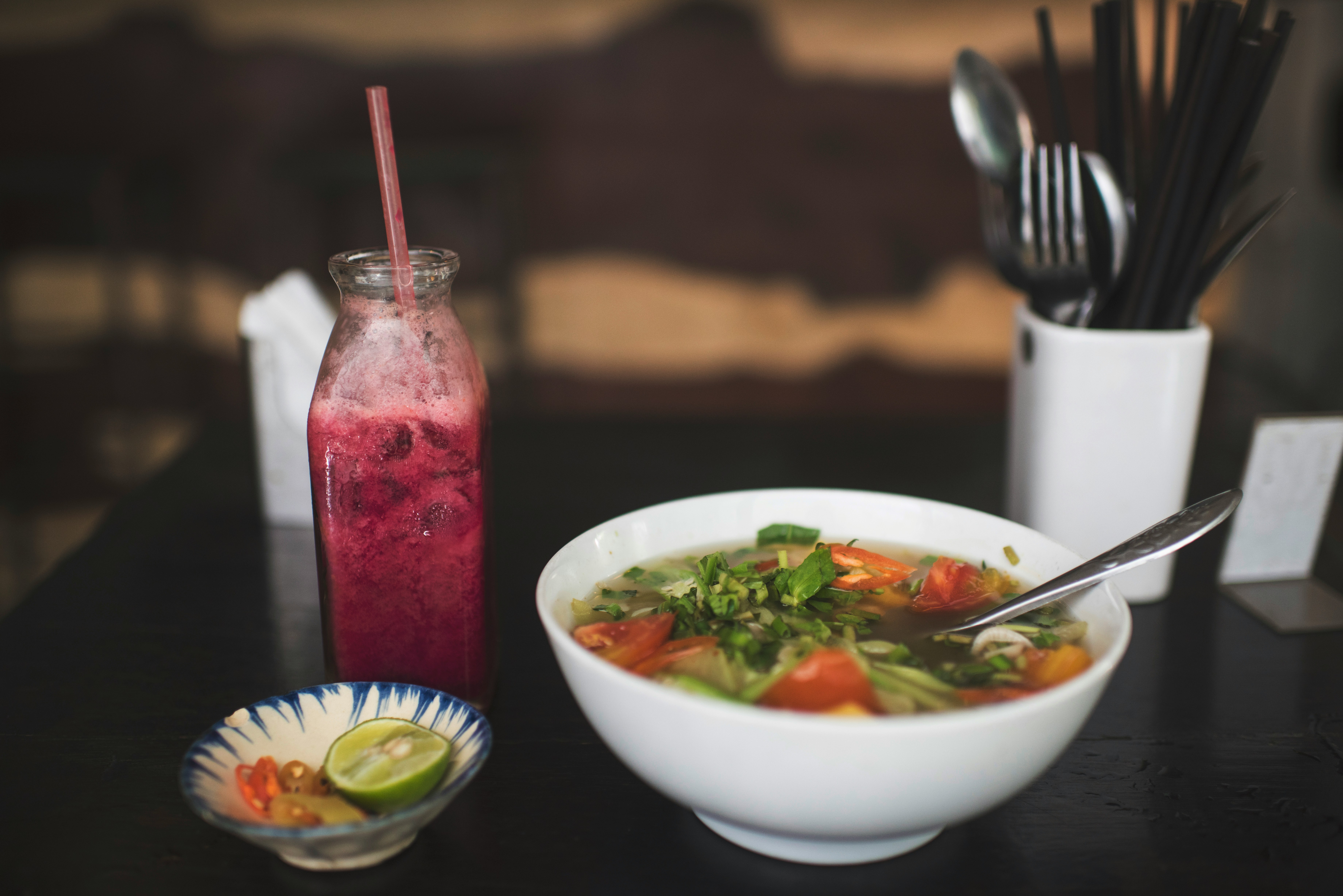
Where banh canh uses thick glutinous noodles, bun ca uses thin vermicelli rice noodles in a tomato-tinged broth with whole pieces of fried or steamed fish. The combination of the bright tomato base, the clean fish flavour and the aromatic herbs (Vietnamese mint, perilla, banana flower) makes bun ca one of the more refreshing noodle soups in the country.
In Mui Ne, the fish used is typically fresh from the previous night’s catch — often catfish, snakehead or a small white-fleshed sea fish depending on availability. The Phan Thiet region’s fish sauce goes into the broth and sets the dish apart from versions you’ll find inland.
A bowl costs approximately 35,000–55,000 VND at a street stall.
Where to eat it: Quan Bun Ca 80 on Nguyen Dinh Chieu (the main beach road through Mui Ne) has been operating for decades and is frequently recommended by locals. Open for breakfast and lunch only.
Fresh Seafood: What to Order and What to Watch For
The beach restaurants between Nguyen Dinh Chieu and the water serve live seafood priced by weight — you choose from the tanks or ice boxes at the front, then it’s cooked to order. This is the best way to eat in Mui Ne if you’re willing to do a little due diligence.
What’s worth ordering:
- Ngao hap xa (steamed clams with lemongrass): The clams from the bay are small, sweet and very fresh. Steaming with lemongrass, chilli and fish sauce is the classic preparation. Approximately 80,000–150,000 VND per portion depending on size and restaurant.
- Tom nuong muoi ot (salt and chilli grilled prawns): Prawns grilled over charcoal with a salt-and-chilli crust. Simple and very good when the prawns are fresh. Approximately 150,000–250,000 VND per 300g portion.
- Muc nuong (grilled squid): Whole squid grilled flat over coals and served with lime salt dipping sauce. The squid from the Phan Thiet bay is tender with a slightly sweet flavour. Approximately 100,000–180,000 VND per portion.
- Ca song kho to (clay pot fish): Freshwater or saltwater fish braised in a clay pot with caramel, fish sauce and chilli — a southern Vietnamese preparation that’s particularly good with the local fish varieties. Approximately 120,000–200,000 VND.
What to watch for:
The beach restaurant strip is not uniformly good. Prices vary significantly between almost-identical-looking restaurants, and some charge tourist prices without the quality to match. Before sitting down: check that the seafood tanks look clean and active, ask the price per kilogram rather than accepting a quoted portion price, and confirm whether the price includes cooking charge (sometimes added separately).
The best approach is to walk the strip between roughly 5 Hamlet and the eastern end near Suoi Tien before committing. The restaurants with actual Vietnamese families eating inside are usually the most reliable indicator of quality and fair pricing.
The Beach Restaurant Scene
Mui Ne’s beach restaurant strip runs for about 10 kilometres along Nguyen Dinh Chieu from Ham Tien in the west to the main Mui Ne fishing village in the east. The western end (closer to Ho Chi Minh City) is more resort-oriented and expensive. The eastern end, near the village, is cheaper and more local in character.
Most beach restaurants operate a similar model: plastic tables and chairs in the sand or on a covered terrace, live seafood displayed at the entrance, a menu that runs from seafood to grilled meats to fried rice. Sunset is the prime time — restaurants fill quickly from around 5:30pm, and the best tables with sea views go first.
Good options along the strip:
Bong Sen Restaurant Nguyen Dinh Chieu, eastern section near the village. One of the longer-running operations on the strip, known for consistently fresh seafood and fair pricing. The grilled clams and prawns are reliably well-cooked. Approximately 200,000–500,000 VND per person for a shared seafood meal.
Sung Hung Restaurant Nguyen Dinh Chieu, mid-section near the Mia Resort. A little smarter than the average beach stall — covered terrace, decent lighting, tablecloths. Better for groups or if you want a more comfortable setting. Approximately 250,000–600,000 VND per person.
Vo Thi Sau Street (village area) Walk one block inland from the beach into the fishing village and the prices drop by 40%. This is where the stalls selling banh canh, bun ca, and simple com dia (rice plate) lunches operate. No ocean views, but the food is often better than what’s served beachside, and a full meal costs approximately 50,000–80,000 VND.
Phan Thiet Fish Sauce
Worth mentioning separately because it’s one of Vietnam’s best and is omnipresent in local cooking. Phan Thiet (the city adjacent to Mui Ne) has been producing nuoc mam from anchovies in wooden vats for over a century. The best brands — Phan Thiet Mam, Red Boat’s local equivalent — have an amber clarity and a savoury depth that the industrial versions sold in supermarkets elsewhere can’t match.
Several shops along Nguyen Dinh Chieu sell it in sealed bottles for approximately 50,000–100,000 VND per litre (as of 2026). If you’re travelling with luggage capacity, it makes an excellent purchase — check airline regulations on liquids if flying home.
Breakfast in Mui Ne
The fishing village end of Mui Ne does proper Vietnamese breakfast. Banh mi carts start around 6am (approximately 20,000–30,000 VND per sandwich). Pho and bun bo are available at a handful of stalls along Huynh Thuc Khang Street. If you’re staying at a resort, the buffet breakfasts are generous but generic — worth escaping to the village at least once during your stay for something more authentic.
Banh mi Huynh Thuc Khang: No signage, but the stall at the junction of Huynh Thuc Khang and Nguyen Dinh Chieu is widely known among locals. The baguettes are fresh from a nearby bakery and stuffed with pate, cold cuts, pickled carrot and coriander. Approximately 20,000–25,000 VND each.
Vegetarian and Vegan Options
Mui Ne is not as well-equipped for plant-based eating as Hue or Hoi An, but options exist. Several beach restaurants have a vegetarian section on the menu, usually fried rice, stir-fried vegetables and tofu dishes. The most consistent option is the vegetarian-forward restaurants near the western end of the strip in Ham Tien, which serve a mix of Vietnamese and Western dishes.
Take a Guided Food Tour of Mui Ne and Phan Thiet
The best eating in the Mui Ne area is in Phan Thiet town, 7km from the beach resort strip — the banh canh cha ca specialists, the fish sauce factory district on the Ca Ty River, and the local market where fishermen sell their morning catch directly are all in the town, not on tourist row. A guided food tour covers the Phan Thiet market at dawn, at least one family-run banh canh cha ca restaurant (the thick noodle and fish cake soup unique to this coast), and the fish sauce production area where Phan Thiet’s famous nuoc mam has been made for over a century. For visitors based in Mui Ne beach, the gap between the resort food and what locals actually eat in Phan Thiet is one of the most striking contrasts in Vietnamese coastal tourism.
Book a guided food tour in Mui Ne on GetYourGuide
Practical Notes
- Market hours: The Phan Thiet fish market (about 15 minutes by taxi from central Mui Ne) is most active 4–6am when the boats return. Worth a visit even if you’re not buying — the scale of the catch is impressive.
- Transport: Mui Ne has no reliable public transport along the beach road. Taxis (Grab available) or rented motorbikes are the practical options for moving between restaurants.
- When to eat: Seafood restaurants are at their best in the evening, from 5pm. For banh canh and bun ca, arrive before 10am — these stalls sell out.
- Budget range: A simple local meal (noodle soup + drink) runs approximately 40,000–70,000 VND. A shared seafood spread at a beach restaurant (2–3 people) runs approximately 400,000–900,000 VND depending on what you order.
- Haggling: Not expected at established restaurants. If a price seems high at a beach seafood place, asking “can you do a better price?” is reasonable and usually produces a modest discount without offence.
- Dragon fruit: The Binh Thuan province around Mui Ne produces around 60% of Vietnam’s dragon fruit. You’ll see it everywhere — in smoothies, at market stalls, on dessert menus. The red-fleshed variety (ruot do) is sweeter and more complex than the white-fleshed type. A kilogram at a market stall costs approximately 15,000–30,000 VND.
Plan Your Trip
Book food tours in Mui Ne Get travel insurance Stay connected with a Vietnam eSIM